
At the start of 2026, the printing market does not look like a single industry moving in one direction. Commercial printers, packaging converters, label specialists, book producers, and wide-format shops are responding to very different demand signals. Yet the most important printing industry news 2026 has a common thread: capacity decisions are becoming more selective, cost exposure is being managed closer to the pressroom, and buyers expect faster, more flexible, and more traceable production.
For information researchers, the challenge is separating short-lived announcements from changes that affect operating models. A new press launch may attract attention, but its real significance depends on workflow compatibility, labor availability, substrate access, energy intensity, and the type of orders entering the market. In 2026, the questions behind the headlines are increasingly practical: Where is capacity still being added? Which costs can printers pass through? Which print segments are resilient? And where is digital production genuinely replacing older workflows rather than simply sitting beside them?
This market overview examines those signals through the lens of production capacity, input economics, sustainability obligations, and regional demand. It is intended as a working reference for researchers, distributors, suppliers, and business teams following the evolution of global printing.
Capacity is expanding—but not in the old “more machines” sense
Printing investment in 2026 is less about building the largest possible pressroom and more about removing bottlenecks across the production chain. A printer may add digital capacity not because offset is disappearing, but because short runs, versioning, repeat ordering, and tighter delivery windows make traditional setup economics less attractive for part of the order book.
That distinction matters. The strongest capacity upgrades often combine equipment with workflow changes: automated prepress, centralized color control, online job intake, production scheduling, finishing automation, and better material tracking. A press that runs quickly but waits for files, plates, approvals, or finishing capacity does not create the responsiveness buyers are seeking.
Digital printing remains central to this shift, especially in labels, flexible packaging, folding cartons, transactional communications, personalized direct mail, décor, and selected commercial applications. The value proposition is no longer limited to “shorter runs.” Digital systems support a different way of planning production: jobs can be grouped by substrate, color profile, finishing requirement, or delivery destination, reducing waste between frequent order changes.
Conventional printing is still deeply relevant where volume, stable artwork, and repeatability support it. Packaging converters serving long-established food, beverage, household, and industrial brands will continue to rely on flexographic, gravure, and offset processes where they remain economically appropriate. The 2026 story is therefore not digital versus analog. It is a rebalancing of the production mix, with hybrid workflows becoming more valuable.
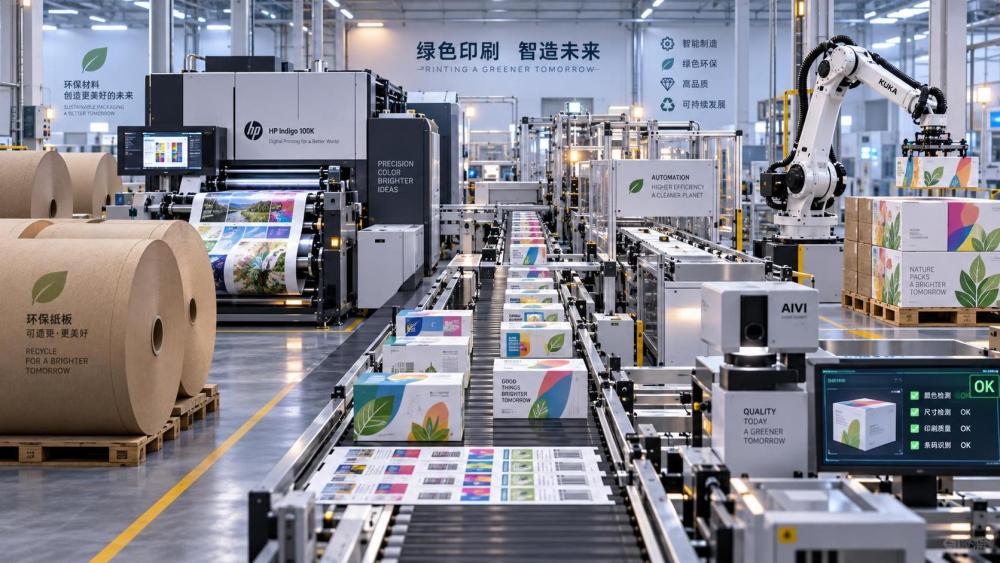
Researchers should watch how suppliers describe automation around a press rather than only the press specifications themselves. Robotic loading, inline inspection, automated plate handling, closed-loop color management, digital embellishment, and connected finishing may reveal more about a site’s future competitiveness than a marginal increase in print speed.
Cost pressure has moved beyond paper prices
Paper, board, ink, coatings, adhesives, energy, transport, and labor continue to shape margins, but their impact is not uniform. A book printer may be highly exposed to paper availability and freight conditions. A label converter may be more sensitive to films, specialty adhesives, compliance documentation, and changeover losses. A commercial printer handling fragmented work may feel labor and administrative costs more sharply than raw-material inflation.
This is why pricing in the printing market is increasingly tied to production complexity. Two jobs with the same sheet count can have very different profitability when one requires multiple versions, variable data, specialty finishing, strict color matching, or a fragmented delivery schedule. Buyers who still view printing as a simple unit-price purchase may be surprised by how strongly these operational variables now influence quotations.
Energy remains a strategic issue as well as an accounting line. Drying, curing, climate control, compressed air, and material handling can all influence the true cost of a run. In regions where energy conditions remain volatile, printers are placing more emphasis on process efficiency, maintenance discipline, and equipment configurations that reduce avoidable consumption. The relevant measure is not merely energy used per hour, but energy used per sellable output after setup waste, reprints, and downtime are considered.
Why procurement teams are changing their questions
More print buyers are asking for cost transparency around material substitution, minimum order quantities, lead times, and sustainability-related specifications. They want to know whether a lower-cost substrate affects print performance, recyclability, migration risk, shelf appearance, or line efficiency downstream. In response, printers and converters need stronger technical conversations with customers—not just faster quotes.
A useful research approach is to map costs by application rather than treating “printing” as one category. Paper-based publishing, corrugated packaging, pressure-sensitive labels, flexible packaging, retail graphics, and security printing each face different risk patterns. This makes broad forecasts useful only as a starting point; investment decisions need segment-level interpretation.
Packaging demand remains a stabilizer, but it is becoming more demanding
Packaging continues to provide an important base of print demand in 2026. Food, healthcare, personal care, e-commerce, industrial parts, and consumer goods all require labeling, protection, information, and brand presentation. But demand is not automatically easy demand. Brand owners are reducing complexity in some product lines while adding variations in others, particularly where regional language requirements, promotional formats, and online sales channels create more SKUs.
That creates a paradox familiar to many converters: total volume may be steady, while job administration grows. Shorter campaigns, mixed-version packs, frequent artwork revisions, and traceability requirements create pressure on prepress and quality systems. The packaging printer with the best response is not necessarily the one with the most capacity. It is the one able to maintain control when the job mix becomes less predictable.
Compliance also has a larger presence in customer conversations. Food-contact packaging, chemical migration considerations, recycling claims, material declarations, and extended producer responsibility rules vary across markets. Printers do not set every regulatory requirement, but they increasingly sit in the middle of the information chain between material suppliers, brand owners, and converters.
For this reason, packaging investment increasingly includes inspection, documentation, and data connectivity. A defect detection system or a more disciplined substrate-record process may appear less visible than a new press, but it can be essential when customers need confidence that every version and batch can be traced.
Sustainability is becoming an operational filter
Sustainability in printing is moving away from broad claims and toward production choices that can be explained. Customers are asking about fiber sources, recycled content, ink systems, waste handling, pack weight, recoverability, and the practical effects of replacing one material with another. The direction of travel is clear, even where local rules and infrastructure differ: print suppliers are expected to understand the environmental trade-offs embedded in their work.
One common mistake is assuming that a sustainable print strategy is simply a matter of selecting a recycled or lighter substrate. Material changes can alter opacity, stiffness, ink absorption, drying behavior, color appearance, converting performance, and product protection. A lower-material solution that causes spoilage, breakage, or higher reject rates can undermine its original purpose.
The more credible approach is systems thinking. It considers artwork design, print process, substrate, finishing, logistics, end-of-life conditions, and actual consumer use. This is particularly important in packaging, where visual impact, barrier performance, safety, and recyclability may pull in different directions.
At GSI-Matrix, this kind of system integration is central to how specialized manufacturing intelligence is interpreted. Printing developments become more meaningful when connected to papermaking inputs, packaging compliance, automation technologies, and changing production economics. The most useful market signal is rarely isolated; it is usually the point where several industrial systems begin to affect one another.
Demand is fragmenting by region and end market
Global print demand in 2026 cannot be read through a single regional narrative. Mature markets may show restrained growth in traditional commercial work while maintaining demand for premium packaging, labels, books, direct communications, and high-value specialty print. Emerging markets may generate demand through retail expansion, urban development, local manufacturing, education, consumer goods distribution, and basic packaging capacity.
Regionalization is influencing print supply as well. Brands seeking shorter supply chains or more responsive replenishment can favor local and regional converters, especially for packaging and promotional materials. At the same time, cross-border sourcing remains relevant for specialized print, high-volume production, and complex components where process knowledge or installed equipment is concentrated.
Researchers should avoid treating geographic growth as a guarantee of printer profitability. Rising consumer demand may encourage new capacity, but profitability depends on substrate supply, technical labor, financing conditions, service support, and the ability to build reliable distribution channels. In many markets, the shortage is not demand alone; it is integrated capability.
What the 2026 updates mean for equipment and technology decisions
Equipment selection is becoming a workflow decision. Before comparing presses, buyers should examine the full job path: how files arrive, where approvals slow down, how color is controlled, which finishing steps create queues, what data must be recorded, and how operators move between tasks. The right equipment is the one that improves the entire production system rather than adding isolated capacity.
Several evaluation questions are especially relevant in 2026:
- Does the proposed system match the expected run-length mix, not only today’s largest jobs?
- Can it operate with available labor skills and realistic service support?
- How will it connect with existing prepress, MIS, color, inspection, and finishing workflows?
- What substrates and consumables does it require, and how exposed are those inputs to supply disruption?
- Can production data be used to reduce waste, improve scheduling, and support customer reporting?
- Will the investment help meet packaging, safety, or environmental documentation requirements?
These questions also apply to distributors and industry observers. A machine launch should be assessed not only by technical novelty, but by the operating conditions it assumes. Technology that performs well in a highly automated plant may require different support, training, and process adaptation in a developing market or a family-owned commercial print business.
Signals worth monitoring through the rest of the year
The most useful printing industry news in 2026 will likely emerge from patterns rather than one dramatic event. Watch for consolidation among converters seeking scale in procurement and compliance. Monitor whether digital installations are accompanied by finishing and software upgrades. Track material announcements alongside recycling infrastructure and regulatory changes. Pay attention to hiring and training activity, because automation does not eliminate the need for skilled operators, color specialists, maintenance teams, and production planners.
It is also worth following the relationship between pulp markets, paper availability, and print buying behavior. When input uncertainty rises, customers may shorten purchase commitments, adjust specifications, or seek alternative materials. Those actions ripple through publishers, brand owners, print brokers, and production plants long before they appear in broad market reports.
A market defined by connected decisions
The printing sector in 2026 is not simply adapting to higher costs or adopting more digital technology. It is learning to operate as a connected manufacturing system. Capacity depends on workflow. Sustainability depends on material performance and end-of-life reality. Packaging growth depends on compliance discipline. Demand depends on regional supply chains and the ability to deliver many versions without losing control of quality.
For researchers, that is the practical takeaway. The strongest market insights come from linking equipment investment to production behavior, material conditions to margin risk, and customer demand to the operational work required to serve it. As GSI-Matrix continues to track specialized manufacturing sectors, printing should be viewed not as an isolated production activity, but as a vital link between industrial inputs, brand communication, consumer goods, and modern supply networks.
Related News
- Industrial Trends Reshaping Equipment InvestmentMay 13, 2026Industrial trends are redefining equipment investment. Discover how automation, efficiency, modular design, and compliance shape smarter, lower-risk decisions.
- Greening Manufacturing: Where Energy Savings Pay BackMay 09, 2026Greening manufacturing starts with faster payback. Learn how integrated upgrades cut energy waste, improve uptime, and turn hidden efficiency gains into measurable factory returns.
- Production Line Optimisation: Find the Constraint Before Funding New EquipmentSep 24, 2026Production line optimisation starts by finding the true constraint. Learn how to lift good output, reduce waste, and make smarter equipment investment decisions.
- Manufacturing Infrastructure Analysis: Identifying Capacity and Utility BottlenecksSep 22, 2026Manufacturing infrastructure analysis reveals hidden capacity and utility bottlenecks, helping manufacturers improve uptime, output, quality, and expansion readiness.