
A manufacturing intelligence system should be chosen as a decision infrastructure, not as a dashboard purchase. Its value lies in whether it can turn fragmented production, quality, maintenance, energy, and commercial data into actions that improve throughput, reduce avoidable loss, protect product consistency, and guide capital allocation.
The central selection question is not whether a platform offers AI, real-time visibility, or cloud connectivity. Most systems can claim those capabilities. The harder question is whether the system can represent how a specific factory actually creates value: where constraints form, how materials and recipes affect output, which quality signals matter, how operators respond to deviations, and which decisions can be changed early enough to improve the result.
For process-intensive and mixed manufacturing environments—such as textiles, printing, paper, packaging, food-contact converting, woodworking, or building-material production—generic data collection is rarely sufficient. The chosen intelligence layer must connect machine conditions with process context and business consequences.
Start with the operational decision that needs improvement
Factory optimisation initiatives often begin with a broad objective such as “increase efficiency” or “digitise the plant.” Those aims are reasonable, but they are too broad to evaluate an intelligence system. A platform should instead be assessed against a defined decision problem.
Examples include identifying why a converting line loses speed after a material change, determining whether recurring print defects originate in prepress data or press conditions, reducing unplanned stoppages on a bottleneck machine, reconciling reported output with actual sellable production, or deciding whether a capacity constraint requires a new asset rather than process redesign.
Each problem requires different data, timing, and analytical depth. A system designed mainly for executive reporting may show that overall equipment effectiveness has declined, but it may not expose whether the loss came from micro-stoppages, cleaning cycles, web breaks, setup variation, upstream material inconsistency, or downstream accumulation. Conversely, a highly technical condition-monitoring tool may detect abnormal vibration but contribute little to scheduling, yield management, or investment planning.
Before comparing vendors, define the specific decisions the system must support and the users who will act on them. The output should be more precise than a list of desired features. It should state:
- the decision to be improved;
- the production or commercial consequence of a poor decision;
- the data required to make the decision reliably;
- the acceptable delay between an event and an actionable insight;
- the operational owner responsible for acting on the result.
This discipline prevents a common mistake: selecting a visually impressive platform that produces information but does not alter daily operational choices.
Data integration is not the same as data availability
Many factories already hold substantial amounts of data in PLCs, SCADA systems, historians, MES applications, ERP platforms, laboratory systems, maintenance software, spreadsheets, and supplier portals. The selection issue is not simply whether a manufacturing intelligence system can connect to these sources. It is whether the resulting data model preserves the meaning of the production process.
A machine tag labelled “speed” is not useful by itself. It must be associated with the relevant order, product specification, recipe, material batch, operating mode, shift, quality status, downtime state, and potentially the upstream or downstream condition that influenced it. Without this context, the platform may generate attractive charts while creating misleading comparisons.
Integration should therefore be examined at three levels.
Equipment connectivity. The platform needs practical support for the protocols and control environments used on site, including older equipment that may have limited digital interfaces. A system that works only with new, standardised machines can create blind spots in factories where legacy lines still carry a significant share of volume or revenue.
Operational context. It should connect machine events to production orders, bill-of-material information, product variants, quality checks, maintenance records, and labour or shift structures where relevant. In a packaging plant, a change in reject rate has limited value unless it can be traced to a particular substrate, adhesive, artwork version, forming process, or inspection standard.
Data governance. Decision-makers need clarity on data ownership, retention, access rights, audit trails, and exportability. These points become especially important when production information is shared across sites, contract manufacturers, technology partners, or cross-border operations. A platform should not make a factory dependent on opaque data structures that cannot be independently validated or transferred.
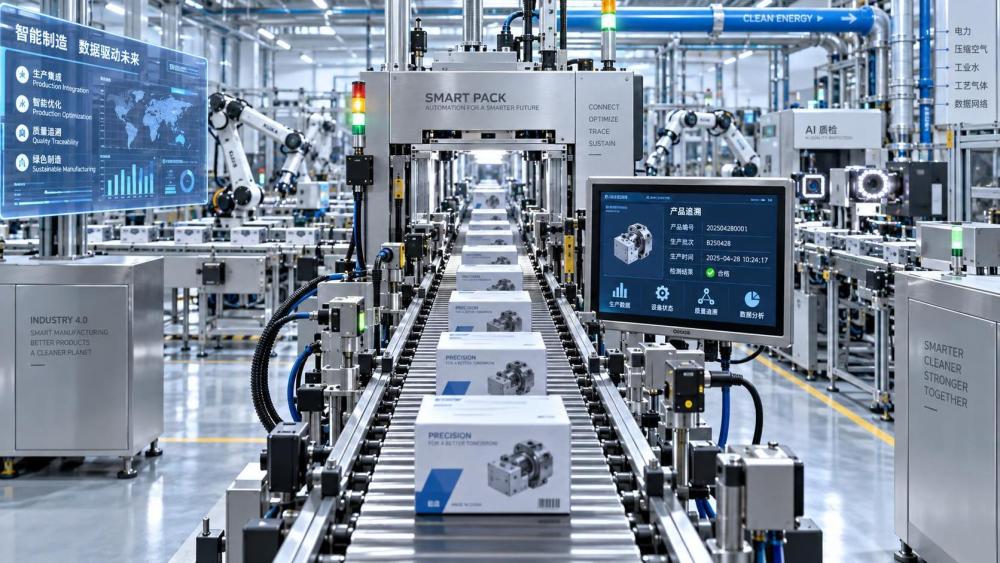
Ask suppliers to demonstrate a full production event from source to decision screen: a machine condition, its associated order and material lot, its quality result, the calculation applied, and the action triggered. A generic connector list is not evidence that this chain works in a real production environment.
Vertical process knowledge determines whether analytics are credible
Manufacturing intelligence is often discussed as though factories differ only in equipment type. In reality, the logic of loss, quality, and control varies substantially between sectors and processes.
In papermaking, fibre characteristics, moisture, basis weight, drying conditions, and reel quality may interact across a continuous process. In digital textile printing, colour management, fabric preparation, ink behaviour, curing, and design-file control can all affect the final result. In packaging conversion, line efficiency can be shaped by substrate variability, changeover sequencing, adhesive performance, sealing integrity, print registration, and compliance documentation. A generic platform may capture these variables, but it cannot automatically determine which relationships are operationally meaningful.
This is why vertical process models matter. The preferred system should allow plant specialists to define product-specific quality parameters, production states, loss codes, recipes, and acceptable operating windows without requiring extensive custom software development for every change. It should also distinguish between a normal variation and an exception that deserves intervention.
Sector knowledge should not be confused with a rigid preconfigured template. A platform that forces every factory into a fixed model can be as limiting as one with no manufacturing logic at all. The useful balance is a configurable core: standard industrial data structures and analytics, combined with the ability to reflect local process routes, quality rules, and performance measures.
When evaluating vendors, test their understanding with scenarios that matter to the plant. Ask how the system would investigate a defect pattern that occurs only on one product family, after a particular changeover, or under certain environmental conditions. The quality of the answer will reveal more than a long feature presentation.
Real-time capability matters only when the response can be real-time
Real-time visibility is valuable when a delay changes the cost or recoverability of an event. If a web break, temperature deviation, registration error, contamination risk, or material shortage can be corrected during the run, then short-latency monitoring can prevent scrap, downtime, or customer risk. If the information is used for weekly planning or monthly asset review, minute-by-minute refresh rates may add cost without improving the decision.
The right system matches information speed to operational response speed. This distinction is particularly important because high-frequency data can quickly become expensive and difficult to govern. Collecting every available signal is not a strategy. It may overload networks, complicate data storage, and obscure the small set of variables that operators and engineers can realistically influence.
A sound selection process separates three analytical horizons:
- Immediate control: alerts, interlocks, operator guidance, and rapid escalation for conditions that threaten safety, quality, or output.
- Shift and daily optimisation: loss analysis, schedule adherence, changeover performance, quality trends, and maintenance prioritisation.
- Strategic improvement: capacity planning, product profitability, energy intensity, asset replacement, network design, and investment evaluation.
The same platform does not need to perform every function natively. It does, however, need to exchange information reliably with the systems responsible for each horizon. A strong architecture often combines operational technology data, manufacturing execution data, enterprise information, and specialised analytical tools rather than attempting to replace all existing applications.
Measure optimisation through constraints, not headline KPIs alone
Overall equipment effectiveness, output per shift, waste rate, on-time delivery, and energy use are useful measures. They are not always sufficient measures of optimisation. Improving a local KPI can shift a problem elsewhere in the production flow.
A line may increase its reported speed while creating more downstream rejects. A maintenance team may reduce breakdowns by extending preventive tasks, yet increase planned downtime on the plant’s true constraint. A purchasing change may reduce material cost while increasing setup instability, print variation, or waste. An intelligence system should help reveal these trade-offs instead of rewarding isolated improvement.
This requires the platform to model production flow across equipment and departments. It should identify where queues accumulate, where starving or blocking occurs, which asset limits shipment volume, and whether the limiting factor changes by product mix. In batch operations, it should also show how waiting time, cleaning requirements, batch sequencing, and quality release affect effective capacity.
The financial link must be explicit. A reduction in downtime has different value depending on whether it occurs at a bottleneck, on a line with spare capacity, or during a period of low demand. Similarly, a quality improvement matters differently when it reduces internal rework, avoids customer claims, protects regulatory compliance, or enables a higher-value product specification.
When considering how to choose a manufacturing intelligence system for factory optimization, the most useful question is: can the system connect operational loss to the economic constraint of the business? If it cannot, it may improve reporting while leaving investment priorities unclear.
Examine implementation burden before committing to scale
Implementation risk is frequently underestimated because software demonstrations rarely expose the work needed to make data trustworthy. Tags must be mapped, loss definitions agreed, master data reconciled, product and order structures aligned, cybersecurity controls reviewed, users trained, and operational ownership established. None of these tasks is merely technical. They require agreement on how the factory defines performance.
A platform with extensive flexibility may require significant internal data engineering and process-design capability. A more prescriptive system may deploy faster but limit future use cases. The better choice depends on the organisation’s ability to sustain configuration, data quality management, and change control after the initial project team has moved on.
Selection should include a limited but demanding proof phase. It should cover a representative production area rather than the simplest available machine. The test should include at least one integration challenge, one quality or traceability question, one downtime or performance-loss question, and one management-level decision. The purpose is not to create a polished pilot dashboard; it is to verify that the platform can survive real operating conditions.
Evaluate the supplier’s delivery model as closely as the software. Key questions include who configures process models, how changes are managed, what support is available across relevant regions and time zones, how upgrades affect custom integrations, and whether the organisation can retain control of its own data definitions.
Scalability should preserve comparability without erasing local reality
Multi-site manufacturers need comparable performance information, but forced standardisation can damage the usefulness of local data. A textile mill, a packaging conversion site, and a print facility may all report waste, output, and downtime, yet their definitions and controllable causes may differ.
The right architecture supports a common governance layer while allowing site-level process detail. Group leadership may need consistent measures for asset utilisation, service performance, quality cost, energy intensity, and capital priorities. Site teams need granular views of machine states, recipes, defect categories, and operating windows. Both levels must be linked, not treated as separate reporting worlds.
Scalability also includes commercial and technical resilience. Confirm how the system handles additional lines, factories, acquisitions, new product categories, and changing compliance requirements. Review identity management, role-based access, network segmentation, backup arrangements, and business continuity procedures. Manufacturing intelligence becomes increasingly critical as it influences production decisions; its failure, corruption, or unauthorised access can have operational consequences.
Sustainability data must be decision-grade
Energy, water, emissions, material yield, and waste are increasingly important management variables, but they should not be added as a separate reporting layer disconnected from production. Decision-grade sustainability intelligence links resource consumption to products, orders, machines, operating conditions, and quality outcomes.
For example, a rise in energy use may be justified if it accompanies a more demanding product specification, but it requires investigation if it occurs without a corresponding change in production mix or quality. Scrap reduction is more meaningful when the system distinguishes recoverable trim, reworkable material, rejected finished goods, and material sent outside the process. These distinctions affect both cost and environmental performance.
A system should support traceable calculation methods and clear data boundaries. Claims about product-level environmental performance are only as credible as the allocation logic, meter coverage, material data, and production records behind them. Where external reporting or customer documentation is required, auditability is more important than visual presentation.
Choose for a durable operating model, not a short demonstration
The strongest manufacturing intelligence system is not necessarily the one with the largest feature catalogue. It is the one that creates a dependable chain from shop-floor event to informed action: trustworthy data, meaningful process context, relevant analysis, accountable response, and measurable business consequence.
Selection should favour evidence over promise. Insist on demonstrations using representative workflows, assess integration at the level of actual data meaning, test whether vertical process variables can be modelled, and verify that the platform exposes constraints rather than merely reporting averages. A system that supports these conditions can become a practical basis for factory optimisation, asset-return decisions, and more disciplined operational improvement.
Related News
- Commercial Insights on Global Emerging Markets in PrintMay 14, 2026Global emerging markets insights for print businesses: discover high-potential segments, entry strategies, and risk signals to improve timing, reduce uncertainty, and win faster in growth markets.
- Greening Manufacturing: Which Projects Pay Back Faster?May 14, 2026Greening manufacturing projects that pay back fastest often cut energy, waste, and downtime in 6–24 months. See which upgrades finance teams should approve first.
- When does short run packaging printing cost less than large-volume runs?Sep 22, 2026Short run packaging printing can lower total costs by reducing obsolete stock, storage, and cash risk. Discover the break-even factors for smarter packaging buying.
- What turnaround time should you expect from a direct mail printing supplier?Sep 17, 2026Direct mail printing supplier turnaround times explained: learn the key stages, delay risks, and planning tips for reliable, on-time campaign delivery.