
Packaging format is a production-system decision
A brewery, beverage producer, contract packer, or foodservice supplier rarely chooses kegs only because of the container itself. The format determines how product moves through the plant, how long it remains in circulation, where sanitation risks concentrate, what customers must handle after delivery, and which downstream assets need to be available. Those choices directly shape the scale, configuration, and economic case for a keg filling line.
For business decision-makers, the central question is not simply whether a machine can fill a keg. It is whether the chosen packaging mix supports the company’s sales channels, product shelf-life needs, return logistics, production schedule, and quality-control capability without creating a costly bottleneck elsewhere. A line that appears efficient on a supplier quotation can be poorly matched to a business that has unpredictable keg returns, limited cold storage, frequent product changes, or a growing share of canned and bottled sales.
Kegs remain well suited to draft service, hospitality venues, events, and other high-throughput dispensing environments. They can reduce the amount of single-use packaging entering a distribution loop and allow product to be sold in larger volumes. At the same time, they introduce a reusable-container process that needs cleaning, inspection, tracking, storage, and return coordination. Investment decisions should begin with that operating model rather than with filling speed alone.
Start with the route to market, not the machine specification
Packaging equipment should reflect how customers receive, store, dispense, and reorder product. A producer supplying local restaurants may have short return cycles and practical access to empty kegs. A producer serving a dispersed regional market may face delayed returns, lost assets, inconsistent keg condition, and higher transport complexity. The same filling technology can have very different business value in those two situations.
Decision-makers should map the intended product flow before defining machine requirements:
- Where will filled kegs be sold: on-premise venues, distributors, event operators, or direct accounts?
- How reliably will empty containers return, and who owns the fleet?
- Will the plant fill one keg size or several formats for different customers?
- Are products stable enough for the expected distribution and storage conditions?
- Will the keg line operate as a dedicated shift, alongside canning, or only during selected production windows?
- What happens to product if a keg is rejected after filling or if the line stops during a changeover?
These questions affect more than annual output. They influence the needed keg inventory, wash capacity, buffer storage, labor allocation, utility demand, and inspection procedures. A business that expects irregular demand may prioritize flexible scheduling and quick format changes. One serving a predictable high-volume draft network may place more value on automated handling, consistent cycle times, and integrated cleaning capacity.
Packaging format also affects the value of product loss prevention. Beer, carbonated beverages, and other oxygen-sensitive products can be damaged by poor air removal, incorrect pressure management, or inconsistent sealing. A low-cost line may become expensive if it produces avoidable fill losses, rejects, or quality disputes in the field.
Keg investments must account for reusable-container variability
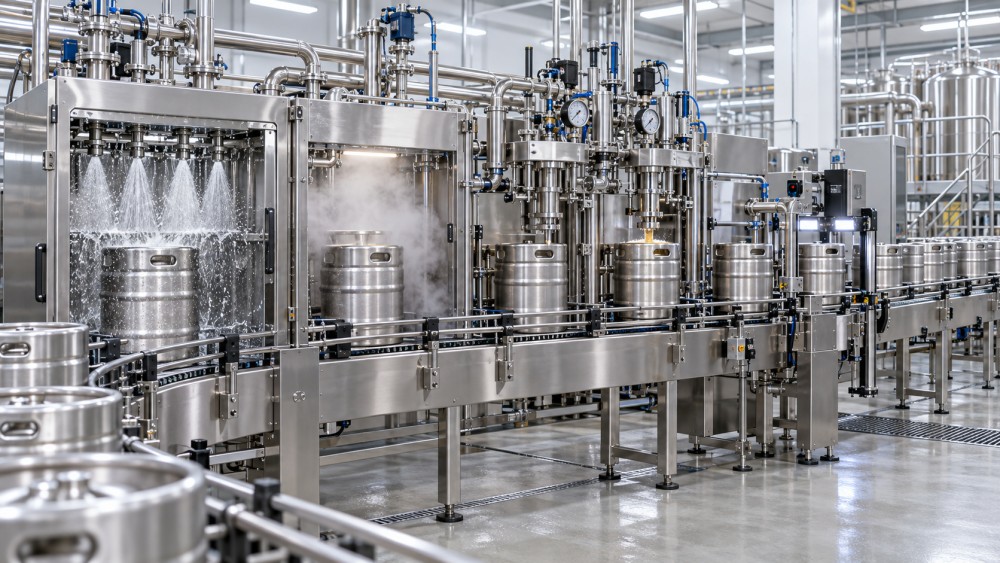
Unlike new cans or bottles delivered in a controlled supply stream, returned kegs may arrive with different levels of external damage, residual product, valve wear, labeling residue, or uncertain handling history. The filling line is therefore part of a broader recovery and sanitation process. Procurement teams should avoid evaluating filling equipment in isolation from keg washing, inspection, and post-fill verification.
The incoming-container condition determines how much automation is genuinely useful. If staff must manually separate damaged, non-compatible, or visibly contaminated kegs before they enter the line, theoretical filling capacity may not be the real production constraint. If a large proportion of containers require extra attention, the business may need better return handling rules, a more standardized keg fleet, or additional inspection resources before investing in a faster filler.
Cleaning and sanitizing capacity must match filling capacity
A filling section cannot run consistently if cleaned kegs are not available at the required rate. In many facilities, the practical throughput of the entire keg operation is set by the washer, cleaning cycle, chemical handling, or drain-down time rather than by the filler itself. The machine investment should therefore be evaluated as a connected process that includes pre-rinse, caustic or detergent cleaning where applicable, rinsing, sanitizing, purging, filling, and closure checks.
The same principle applies to utilities. Water quality, steam or hot-water availability, compressed air, carbon dioxide or nitrogen supply, drainage capacity, and electrical load should be checked early. A machine can meet the nominal production requirement on paper yet underperform when utility pressure fluctuates or when wastewater handling limits the number of cleaning cycles that can be completed during a shift.
Valve compatibility has commercial consequences
Keg valve types vary by market, customer network, and container fleet. A line designed around one coupling or spear arrangement may require change parts, different handling procedures, or additional verification steps when other keg styles enter the operation. Compatibility should be specified in the request for quotation, along with the expected percentage of each keg type and the plan for future format changes.
This is particularly important for companies that fill for multiple brands or contract customers. A seemingly minor difference in valve configuration can affect changeover time, operator training, spare-parts planning, and the ability to respond to short-notice orders. The commercial cost is not limited to the parts themselves; it includes lost line availability when the required configuration is unavailable or incorrectly installed.
Choose automation around repeatability, not appearance
Automation can reduce repetitive manual handling and make filling cycles more consistent, but it is not automatically the right answer for every facility. A smaller producer with limited batches and a stable local market may benefit from a semi-automatic system that is easier to clean, diagnose, and adapt. A high-volume operation with a standardized keg fleet may gain more from automated infeed, washing, filling, discharge, and data capture.
The useful distinction is between automation that addresses a verified operational risk and automation added because it looks advanced in a layout. For example, automated checks may be justified where manual verification has difficulty detecting incomplete purging, abnormal fill conditions, or closure inconsistencies. Automated conveying may be justified where keg handling is physically demanding or where manual movement causes unreliable line pacing. By contrast, a complex handling system may add service dependence without solving a real constraint if production volumes remain modest.
When assessing a keg filling machine, buyers can use many of the same questions applied to beer can filling and seaming equipment: how the system manages product contact surfaces, how consistently it controls the filling cycle, how readily operators can access critical components, and how the line integrates with upstream and downstream operations. The actual choice should still reflect the very different demands of reusable kegs versus single-use containers.
How cans and bottles influence the keg line business case
Keg filling is often part of a mixed-format packaging strategy. Cans may support retail distribution, portability, and longer-distance shipments. Bottles can remain relevant where returnable glass, premium presentation, or established local distribution systems are important. Kegs may serve draft accounts that need high-volume dispensing. The right investment is often the one that lets these formats coexist without forcing the business into inefficient production scheduling.
A producer that fills cans on most days and kegs only for scheduled account deliveries may not require the same level of dedicated keg-line automation as a draft-focused operation. Conversely, a business moving substantial draft volume may find that relying on small-batch keg filling disrupts packaging planning and makes quality verification harder to manage.
Bottle filling and capping equipment offers a useful comparison. Bottle operations typically require attention to bottle supply, breakage risk, cap selection, label application, and change parts for different bottle sizes. Keg operations remove some of those issues but replace them with container return, cleaning, valve compatibility, and fleet management concerns. Neither format is inherently simpler; each shifts operational risk to different stages of the process.
Specify quality controls as acceptance criteria
Procurement documents should translate product-quality expectations into observable requirements. Broad language such as “high-quality filling” does little to prevent disagreement during commissioning. Buyers should define which process stages need monitoring, what records are required, how rejected kegs are handled, and what conditions must be met before the line is accepted.
For carbonated beverages, this commonly includes attention to air removal, gas management, fill repeatability, product temperature conditions, hygienic design, and the ability to clean product-contact circuits effectively. Exact acceptable limits depend on the beverage, process design, and internal quality program, so they should be established by the buyer’s technical and quality teams rather than assumed from a generic equipment specification.
Practical acceptance planning may include trial runs using representative kegs, verification of changeovers, demonstration of cleaning procedures, checks of operator access, and confirmation that alarms or interlocks behave as intended. If the supplier’s test environment cannot replicate the purchaser’s product or keg fleet, the gap should be documented and addressed during site commissioning.
Do not overlook serviceability and operational ownership
A keg line is expected to work in a wet, sanitation-intensive environment. Components exposed to cleaning chemicals, water, pressure cycles, and routine handling need to be accessible for inspection and replacement. Maintenance teams should review the layout before purchase, asking whether valves, seals, sensors, pumps, and fittings can be reached safely without major disassembly.
Spare-parts strategy deserves the same attention as the initial capital price. Some parts are routine consumables, while others may have longer lead times or require specialist support. Buyers should clarify what documentation accompanies the line, whether electrical and pneumatic diagrams are complete, how fault messages are presented, and what training is needed for operators and maintenance staff. A line that cannot be diagnosed quickly can disrupt deliveries even when its mechanical design is sound.
Operational ownership also matters. If one department manages sanitation, another manages packaging, and a third controls quality release, responsibilities should be clear before commissioning. Unclear handoffs are a frequent source of missed cleaning records, incomplete pre-start checks, and delayed response to recurring faults.
Build the investment case around constraints that will remain after installation
The most useful keg filling investment model looks beyond rated machine output. It should include the cost and availability of the keg fleet, cleaning chemicals and utilities, labor for sorting and handling, expected maintenance effort, floor-space constraints, cold-storage needs, product-change frequency, and the financial effect of delayed or missing returns. It should also recognize that a faster filler does not solve an undersized washer, insufficient gas supply, limited loading capacity, or an unreliable delivery loop.
Packaging format decisions shape equipment investments because they shape the entire operating system around the machine. A well-matched keg line supports the sales channels where draft packaging makes commercial sense, maintains product quality through disciplined cleaning and filling controls, and fits the company’s realistic ability to manage reusable assets. The strongest procurement decision is usually the one that aligns capacity, sanitation, container logistics, and format flexibility before the equipment order is finalized.
Related News
- Commercial Insights on Global Emerging Markets in PrintMay 14, 2026Global emerging markets insights for print businesses: discover high-potential segments, entry strategies, and risk signals to improve timing, reduce uncertainty, and win faster in growth markets.
- Greening Manufacturing: Which Projects Pay Back Faster?May 14, 2026Greening manufacturing projects that pay back fastest often cut energy, waste, and downtime in 6–24 months. See which upgrades finance teams should approve first.
- When does smart production line integration pay off for a factory?Sep 27, 2026Smart production line integration pays off when it cuts recurring losses, improves quality, and unlocks flexible capacity. Discover the signs, ROI factors, and practical steps.
- When does short run packaging printing cost less than large-volume runs?Sep 22, 2026Short run packaging printing can lower total costs by reducing obsolete stock, storage, and cash risk. Discover the break-even factors for smarter packaging buying.