
China Industrial Solutions Trends: What Global Manufacturers Should Watch in 2026
Introduction
As global manufacturers refine investment plans for 2026, China industrial solutions trends are becoming a critical benchmark for evaluating automation, low-carbon production, modular equipment, and supply-chain resilience.
For business evaluators, the central question is no longer whether Chinese suppliers can offer competitive machinery. It is whether they can deliver measurable operational outcomes across an entire production system.
That distinction matters in textiles, printing, papermaking, packaging, woodworking, food processing, and building-material production, where isolated equipment performance rarely determines the final return on investment.
The strongest Chinese industrial partners are increasingly competing through line integration, digital controls, energy efficiency, service responsiveness, and adaptation to local regulatory requirements rather than purchase price alone.
Global manufacturers should therefore assess China industrial solutions trends through a commercial lens: capacity economics, operating reliability, compliance exposure, implementation risk, and asset value over the equipment lifecycle.
This article identifies the signals that matter most when evaluating Chinese industrial solutions for 2026, with practical criteria for comparing suppliers, project models, and investment alternatives.
Why System Integration Has Become the Primary Evaluation Issue
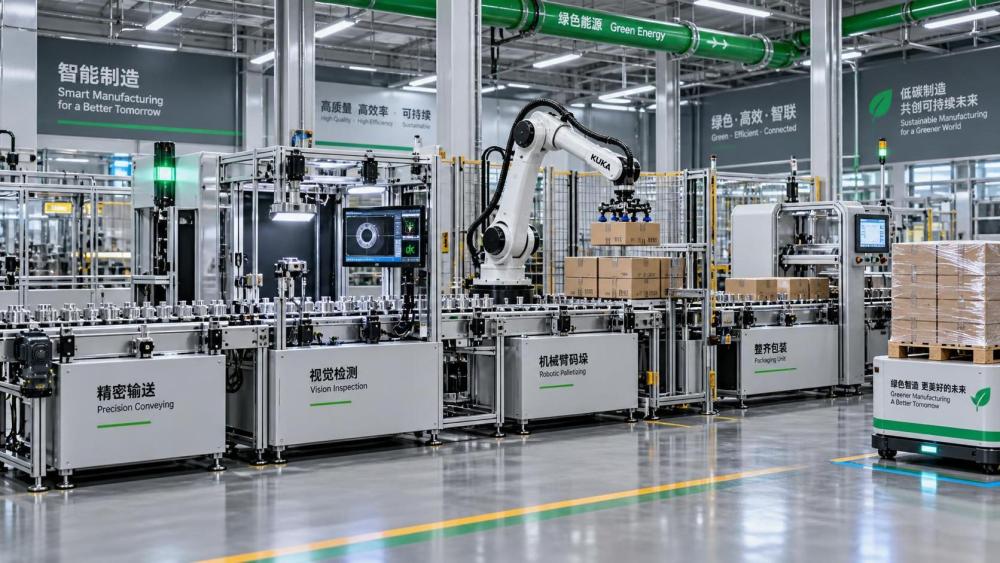
In 2026, machinery procurement decisions will increasingly become production-system decisions. Buyers need compatible equipment, data continuity, reliable material flow, and clear accountability across connected process stages.
A low-priced machine can create a costly project when it requires separate automation vendors, repeated commissioning work, incompatible software, or manual interventions between upstream and downstream operations.
Chinese suppliers are responding by offering broader turnkey packages, combining converting, printing, inspection, conveying, packing, palletizing, utilities, and production-management interfaces within a coordinated scope.
For evaluators, the relevant question is not simply how many machines a supplier manufactures. It is how effectively that supplier manages interfaces, handovers, specifications, and acceptance responsibilities.
Integration capability is especially important in high-volume operations, where a bottleneck at one station can reduce utilization across the entire line and distort planned unit-cost savings.
Request a process map that identifies every transfer point, control boundary, operator task, utility dependency, and data exchange. This exposes hidden engineering gaps before contract negotiations begin.
Strong proposals define line throughput under normal operating conditions, not only peak machine speed. They also state assumptions for material quality, staffing, maintenance windows, and product changeovers.
Business evaluators should ask whether one party owns final performance acceptance. Shared responsibility among multiple vendors often leads to delays when capacity, quality, or integration targets are missed.
The practical value of an integrated solution is shorter commissioning, fewer manual workarounds, clearer troubleshooting, and a better foundation for phased capacity expansion after the initial deployment.
Automation Is Moving From Standalone Equipment to Measurable Labor Productivity
Automation remains one of the most visible China industrial solutions trends, but business cases should focus on labor productivity, output consistency, safety performance, and management visibility rather than automation labels.
In packaging and printing, automated job setup, color control, inspection, material handling, and finished-goods logistics can reduce variation that otherwise creates rework, waste, delayed delivery, and customer claims.
In textile production, automated winding, cutting, handling, quality detection, and recipe management can improve repeatability while reducing dependence on scarce experienced operators during multi-shift operations.
For papermaking and converting lines, automation value often comes from stable web handling, moisture control, defect detection, predictive maintenance signals, and faster response to process deviations.
Evaluators should separate automation into three categories: equipment-level control, line-level coordination, and plant-level decision support. Each category has different costs, benefits, and implementation dependencies.
Equipment-level control improves individual machine performance, while line-level coordination manages sequencing and material flow. Plant-level systems convert operational data into scheduling, maintenance, quality, and cost decisions.
A supplier should demonstrate how its control architecture connects with existing enterprise systems. Closed data environments can limit future upgrades and force buyers into expensive vendor dependence.
Ask for evidence from comparable factories, including baseline labor requirements, actual line availability, reject rates, setup time, and the training period needed before target performance was reached.
Automation investments should also be evaluated against local labor conditions. A highly automated configuration may be appropriate where skills shortages or quality risks outweigh its additional capital cost.
Conversely, operations with volatile product mixes may require flexible semi-automation. The goal is not maximum automation, but the lowest sustainable cost per compliant unit produced.
Low-Carbon Production Will Be Evaluated Through Operating Economics and Market Access
Low-carbon equipment is becoming a commercial requirement, especially for exporters supplying regulated markets, multinational brands, food-contact applications, and customers with formal supplier sustainability reporting obligations.
In 2026, buyers should expect Chinese machinery suppliers to emphasize energy-efficient drives, heat recovery, lower material loss, water reuse, cleaner combustion, and digital monitoring of resource consumption.
These claims require verification. An energy-saving feature has limited value unless the supplier provides operating conditions, utility baselines, expected consumption ranges, and a credible measurement method after commissioning.
For printing operations, low-carbon improvements may involve curing technologies, ink management, registration accuracy, reduced startup waste, and production scheduling that minimizes material and energy-intensive changeovers.
In packaging, the strongest projects consider material reduction alongside machinery efficiency. Precise forming, sealing, cutting, and inspection can lower scrap while supporting thinner substrates or recyclable material structures.
Paper and pulp operations should examine water intensity, steam demand, fiber yield, chemical consumption, and wastewater implications. These variables often have greater financial impact than equipment acquisition cost.
Building-material producers should assess kiln efficiency, raw-material preparation, dust control, waste heat utilization, and compatibility with lower-carbon feedstocks or evolving local construction standards.
Business evaluators should require a lifecycle cost model covering electricity, fuel, water, consumables, maintenance, waste disposal, and anticipated environmental compliance costs over a realistic operating horizon.
A well-designed model also distinguishes theoretical savings from savings available at the buyer's site. Local utility pricing, ambient conditions, material quality, and production patterns materially affect results.
Environmental performance should be treated as both a cost variable and a revenue-protection issue. Better compliance readiness can preserve customer eligibility, reduce audit risk, and support premium market positioning.
Modular Equipment Reduces Expansion Risk When Demand Remains Uncertain
Demand uncertainty is encouraging manufacturers to favor modular production architectures. This is another important China industrial solutions trend because phased investment can protect capital while preserving future capacity options.
Modular equipment does not simply mean smaller machines. It means that capacity blocks, automation modules, inspection systems, utilities, and software can be added without redesigning the entire facility.
This approach is valuable for emerging markets, regional converters, and specialized manufacturers entering new product categories where forecast accuracy remains limited and customer requirements may change rapidly.
For example, a packaging producer may begin with core printing and converting capacity, then add automated inspection, advanced finishing, robotic packing, or traceability functions as order volumes increase.
Textile manufacturers can use modular planning to add digital printing, automated cutting, or quality systems after validating demand, rather than committing immediately to a fully configured high-capital line.
The key evaluation issue is whether the initial installation genuinely supports expansion. Suppliers should specify reserved interfaces, control capacity, floor-space requirements, utility headroom, and upgrade lead times.
Buyers should avoid vague promises that a line is “upgradeable.” Ask for drawings, documented module specifications, previous expansion references, and pricing principles for future additions.
Modularity can also improve resilience by allowing maintenance or replacement of a process block without stopping every connected operation. This is particularly useful in continuous or high-utilization production environments.
However, modular designs can create excessive complexity if interfaces are poorly standardized. Evaluators should confirm that future modules share common controls, safety standards, spare parts, and service arrangements.
A phased investment plan should include decision gates tied to demand, margin, utilization, quality performance, and regulatory conditions. This makes expansion a disciplined business choice rather than an emotional response.
Supply-Chain Resilience Now Includes Parts, Documentation, and Technical Support
Procurement teams increasingly recognize that supply-chain resilience extends beyond delivery of the original machine. It includes spare parts availability, remote support, documentation quality, service capability, and escalation procedures.
Chinese suppliers have improved international delivery capabilities, but performance varies significantly between export-experienced manufacturers and companies whose processes remain primarily designed for domestic customers.
Business evaluators should examine the supplier's overseas service footprint, language capability, local agent structure, critical-parts inventory, and response-time commitments before assigning a resilience score.
A detailed spare-parts list should distinguish consumables, wear items, recommended startup stock, long-lead components, and critical failure parts. Broad catalogues do not replace a site-specific strategy.
Documentation is equally important. Electrical diagrams, pneumatic layouts, software backups, maintenance schedules, safety information, and troubleshooting guidance should be available in usable English before factory acceptance testing.
Remote diagnostics can speed problem resolution, but buyers should clarify cybersecurity requirements, access permissions, data ownership, and procedures for operating without an external network connection.
For critical lines, request a business continuity scenario. It should explain what happens if a controller fails, an imported component becomes unavailable, or travel restrictions delay onsite support.
Supplier resilience should also be assessed through its own sourcing model. Heavy dependence on a single imported component supplier can introduce exposure despite local machinery assembly capabilities.
Contractual terms should state service response targets, defect-resolution responsibilities, warranty boundaries, spare-part lead times, and remedies for performance failures after installation, not merely before shipment.
The most credible partners treat after-sales support as part of industrial performance. This creates a stronger basis for reliable production than a transaction focused only on equipment delivery.
Compliance Readiness Must Be Tested Before Equipment Selection
Compliance requirements are becoming more complex across food packaging, worker safety, electrical standards, emissions, traceability, data security, and product-specific market access rules in destination countries.
Global manufacturers should not assume that an industrial solution designed for one market automatically meets the requirements of another. Certification scope, component specifications, and documentation obligations can differ substantially.
For food packaging equipment, assess hygienic design, cleanability, food-contact material declarations, traceability capability, contamination-control features, and compatibility with the buyer's quality-management system.
For export-oriented printing and packaging operations, color consistency, batch traceability, chemical management, substrate controls, and inspection records can be as important as mechanical production speed.
Safety evaluation should cover guarding, emergency stops, lockout procedures, electrical protection, operator access, noise, dust, heat, and the practical clarity of operating instructions.
Ask suppliers to identify every standard used in their design. Then compare those standards against the destination market, insurer expectations, customer audit criteria, and the buyer's internal engineering rules.
Third-party inspection should be planned early, particularly for complex turnkey projects. Late discovery of nonconformities can delay shipment, increase modification costs, and weaken the expected investment timeline.
Compliance readiness is not merely a legal checklist. It affects project certainty, customer confidence, insurance exposure, and the ability to operate without repeated retrofit work after startup.
How Business Evaluators Should Compare Chinese Industrial Partners
A disciplined supplier comparison should combine technical, commercial, operational, and strategic criteria. Price should remain important, but it should not dominate a decision involving long-lived production assets.
Start with a weighted scorecard covering throughput, quality capability, integration scope, lifecycle cost, compliance, project management, service support, financial stability, and evidence from comparable references.
Require each bidder to state exclusions clearly. Common gaps include civil works, utilities, installation labor, software integration, operator training, consumables, local certification, and post-acceptance support.
Factory acceptance testing should be based on agreed samples, defect criteria, production speeds, changeover conditions, and data capture requirements. Generic demonstrations provide limited evidence of real performance.
Site acceptance testing should measure sustained operation, not short runs. Include defined conditions for material supply, operator competence, utility stability, and downtime classification to prevent disputed results.
Commercial evaluation should include payment milestones linked to verifiable engineering outputs. These can include approved drawings, successful testing, shipment readiness, installation completion, and final operational acceptance.
Reference checks should target customers with similar products, output volumes, export requirements, and operating environments. A successful domestic installation may not predict international project performance.
During reference discussions, ask about commissioning duration, spare-part quality, communication during problems, software reliability, operator learning curves, and the supplier's behavior after final payment.
Where possible, conduct cross-functional evaluation. Operations, maintenance, quality, finance, procurement, and safety teams often identify different risks that a single purchasing-led review can overlook.
The best decision is generally the solution with the strongest risk-adjusted return, not the lowest quoted capital expenditure or the most advanced feature list.
What to Watch During 2026
China industrial solutions trends in 2026 will reward buyers who evaluate production systems as commercial assets rather than collections of individual machines with attractive specifications.
Automation will matter where it improves labor productivity and consistency. Low-carbon design will matter where it lowers operating costs, protects market access, and supports customer sustainability requirements.
Modularity will matter where demand is uncertain, while resilient service models will matter wherever downtime creates material financial or customer-delivery consequences for the manufacturer.
Chinese industrial partners can offer substantial value in specialized manufacturing, particularly when their equipment expertise is matched by disciplined systems engineering, international compliance preparation, and accountable lifecycle support.
For business evaluators, the final test is straightforward: can the supplier demonstrate how its solution will improve unit economics, reduce operational risk, meet compliance needs, and remain serviceable over time?
Organizations that ask this question early will be better positioned to select industrial partners capable of supporting profitable, scalable, and resilient manufacturing investments through 2026 and beyond.