Compatibility Is Conditional, Not Automatic
Specialty paper can often run on standard printing equipment, but compatibility should never be assumed from the sheet’s appearance alone. A smooth metallic stock, a heavily textured cover, a synthetic label material, and a soft uncoated cotton paper may all be described as specialty paper, yet each places very different demands on a press.
For a printer, converter, packaging buyer, or production manager, the useful question is more specific: can this particular substrate run reliably on this press, at the required volume and quality level, without excessive setup time, waste, or finishing failures?
A short digital run on a light textured sheet may work well on a commercial toner press. That does not prove the same stock will feed consistently through a high-speed offset press, accept dense solid ink coverage, tolerate folding, and remain stable during die-cutting. Likewise, a paper that performs well on a sheetfed press may be unsuitable for a heat-intensive digital engine or a web press with limited drying capacity.
The practical answer is therefore: standard equipment is often sufficient for many specialty papers, provided the paper properties fall within the machine’s operating range and the job is set up around the substrate rather than treated as ordinary copy paper.
What Determines Whether a Specialty Sheet Will Run?
“Specialty” is a commercial category, not a technical specification. Press compatibility is determined by measurable or observable properties that affect feeding, image transfer, drying, and conversion. The most important areas are basis weight and caliper, surface treatment, texture, moisture condition, grain direction, and dimensional stability.
Weight and caliper are related, but not interchangeable
Most presses publish acceptable paper-weight ranges. Those ranges are useful, but they do not tell the whole story. Two papers with a similar basis weight can have very different thicknesses. A bulky uncoated sheet may be much thicker than a dense coated sheet of the same weight, changing how it passes through the feeder, transfer section, fuser, delivery stack, and finishing equipment.
Caliper becomes particularly important when a job includes duplex printing, multiple folds, inline coating, embossing, or tight-register die-cutting. A thick sheet can create feeding problems even when its nominal weight appears to fall within the press specification. It can also affect image-to-image registration because the press’s paper path, grippers, pressure settings, and delivery controls were designed around a narrower physical range.
Before scheduling production, compare the supplier’s caliper data with the press manufacturer’s supported media range. For digitally printed work, also confirm any machine limits for coated stock, textured stock, and heavy media in duplex mode. The straight-through paper path sometimes offered on production equipment may expand options, but it does not remove restrictions elsewhere in the workflow.
Surface chemistry matters as much as surface appearance
A specialty sheet may be coated for gloss, tactile feel, water resistance, durability, writing performance, or visual effect. That coating governs how ink, toner, varnish, adhesive, and foil interact with the surface.
In conventional offset printing, a non-absorbent or slow-absorbing surface can delay ink setting. Dense coverage may remain vulnerable to marking in the delivery pile, particularly where drying time is limited or the work must move immediately to finishing. An ink formulation that works on a standard coated sheet may not provide adequate rub resistance or adhesion on a metallized, pearlescent, plastic-laminated, or highly sealed surface.
Digital printing has a different set of sensitivities. Toner-based devices rely on heat and pressure to fuse an image to the substrate. Papers with coatings that soften, release, discolor, or resist toner bonding at elevated temperatures need explicit approval or a controlled trial. Inkjet systems depend on controlled absorption and surface energy. A beautiful non-absorbent sheet may produce weak color density, slow curing, poor dot control, or poor scratch resistance if it lacks an inkjet-receptive coating.
For that reason, “printable” on a paper data sheet should be read carefully. It may refer to offset lithography, laser printing, inkjet, flexography, gravure, screen printing, or only certain ink systems. It should not be interpreted as a guarantee across all standard printing equipment.
Texture can improve the product and complicate the process
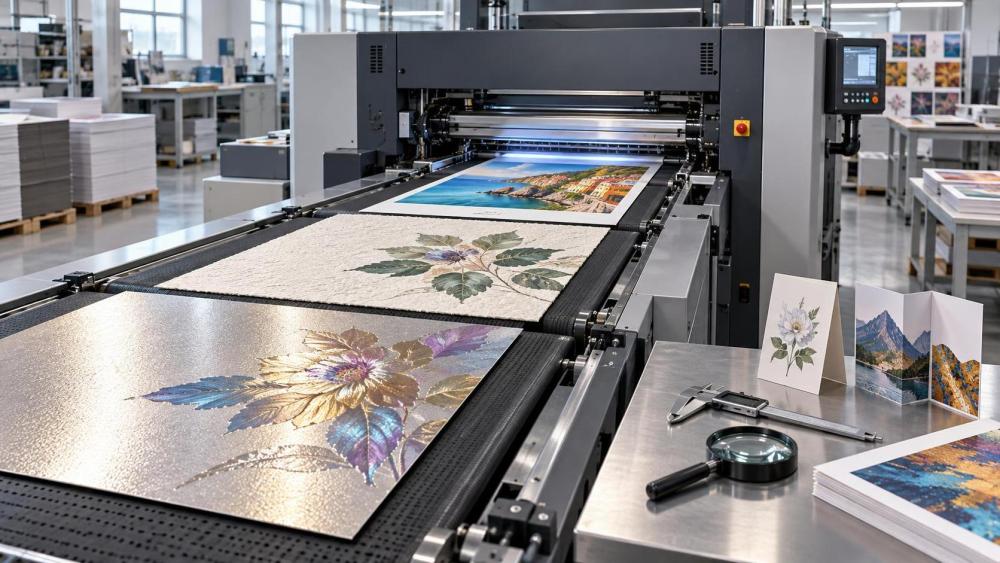
Texture is one of the main reasons buyers choose specialty paper. Laid patterns, felt marks, deep embossing, fibrous surfaces, and handmade effects give invitations, premium packaging, book covers, menus, labels, and presentation materials a tactile distinction that smooth commodity paper cannot provide.
The trade-off is that textured surfaces do not present a uniform printing plane. Fine type, thin rules, small reverse text, and solid areas may print unevenly because ink or toner does not reach every low point in the surface. The result may be intentional and acceptable for an artisanal design, but it is rarely acceptable when a brand requires precise small text, barcode readability, or uniform corporate colors.
Texture also changes the choice of print process. Offset may be suitable for broad commercial work where the image is designed with the paper’s character in mind. Letterpress can make texture part of the visual language, although it has its own constraints on coverage and impression. Digital production may work for lighter textures but requires attention to toner transfer, fusing, and image consistency. For packaging graphics involving large solid colors, a smooth printable face may be a safer choice than a deeply textured substrate.
Standard Presses Have Different Tolerance Profiles
Compatibility should be evaluated against the actual equipment, not against the general label “standard press.” A modern sheetfed offset press, a dry-toner digital press, an inkjet production system, a flexographic label press, and a desktop office printer all move and image paper differently.
The distinction matters commercially. A printer may successfully produce a few samples using manual feed, low speed, and one-sided printing, then struggle when the order moves to automated duplex production. Sample success is useful, but it is only the first stage of qualification. Production compatibility includes repeatability over the intended run length.
Where Failures Usually Appear
Feeding issues are often the first visible problem. Specialty papers can carry more static charge, have irregular edges, contain surface dust, or vary slightly in stiffness from sheet to sheet. These characteristics can lead to double feeds, missed feeds, skewing, and inconsistent registration. Stocks stored in an unsuitable environment can make the issue worse, especially when the paper and pressroom have substantially different humidity conditions.
Even if the sheet feeds cleanly, imaging and finishing can expose a mismatch. Common failure patterns include:
- Uneven solids or broken fine detail on rough, embossed, or highly absorbent surfaces.
- Set-off, scuffing, or slow drying after heavy offset ink coverage on sealed or low-absorbency sheets.
- Weak toner adhesion, image cracking, gloss variation, or coating disturbance after digital fusing.
- Curl, waviness, or loss of flatness after heat, moisture, or one-sided coverage changes the sheet’s balance.
- Cracking along folds when thick, coated, or short-grain stock is folded without scoring.
- Delamination, poor foil transfer, varnish rejection, or adhesive failure during downstream converting.
These are not always paper defects and not always press defects. They are often system problems: paper construction, press configuration, ink or toner behavior, room condition, image design, drying time, and finishing requirements interacting with one another.
This is why a job specification should identify more than paper name, color, and weight. It should state the print process, sidedness, coverage level, finishing sequence, and whether the product has performance requirements such as scuff resistance, writable areas, food-contact suitability, label adhesion, or barcode legibility. A specialty substrate chosen only from a swatch book can create expensive uncertainty later in production.
A Better Qualification Process Before Committing to Volume
The most reliable approach is to qualify the substrate in the intended workflow. Start with the paper manufacturer’s technical data and the press supplier’s supported-media guidance, then move to a representative press trial. The trial should resemble the actual job rather than a simple logo printed in the center of a sheet.
Use the planned image coverage, color areas, fine text, reverse type, and finishing steps. Print both sides where the final job requires duplexing. Run enough sheets to observe feeding and delivery behavior rather than judging only the first few impressions. If the job will be folded, creased, laminated, varnished, glued, foil stamped, or die-cut, process the test pieces through those stages as well.
The review should cover functional outcomes alongside visual quality. Does the sheet remain flat? Does color hold across the run? Is there image offset in stacks? Does black text remain sharp on the chosen texture? Do folds crack? Does the finished surface rub off or show fingerprints? For labels or packaging, does the print survive handling and subsequent conversion?
When adjustment is necessary, change one variable at a time where possible. Press speed, feeder settings, air separation, image density, ink coverage, drying conditions, fuser temperature, and finishing parameters can each influence the result. Changing all of them together may produce an acceptable sample without revealing which condition makes the job stable.
Design Choices Can Make a Marginal Substrate Work Better
Designers and print buyers can reduce risk before a sheet reaches the press. Large dark solids are demanding on textured, absorbent, or slow-drying stocks. Very small type and delicate reverse elements can disappear into a pronounced surface pattern. High-coverage images on one side of a sheet may increase curl or show-through. Designs that accept the paper’s natural variation tend to perform better than those requiring photographic smoothness from an intentionally irregular surface.
Paper grain should also be matched to the finished format. For folded products, grain running parallel to the fold generally improves fold quality and reduces cracking or distortion. The concern becomes more important as the stock gets heavier, more coated, or more rigid.
Color expectations need equal attention. Specialty papers may have a tinted base, visible fibers, metallic particles, or nonuniform surface reflectance. Those qualities alter how printed colors appear. A color target achieved on bright white coated stock may look substantially different on a warm, dark, translucent, or pearlescent sheet. Color management can help establish a controlled target, but it cannot make every specialty surface behave like a neutral coated substrate.
When Standard Equipment Is the Wrong Assumption
Some materials should be treated as specialized substrates from the beginning. Extremely thick boards, rigid synthetic papers, highly heat-sensitive coated materials, heavily laminated constructions, pressure-sensitive label facestocks, and papers with unusual conductive, security, barrier, or release layers may require purpose-built equipment or process-specific qualification.
The same applies when failure has a high cost. Premium packaging, regulated labeling, high-value direct mail, security documents, and products requiring durable graphics leave little room for trial-and-error production. In those cases, the paper choice should be made jointly by the buyer, designer, printer, substrate supplier, and finishing partner before material is ordered at scale.
Specialty paper is therefore compatible with standard printing equipment more often than a simple yes-or-no answer suggests. The right decision comes from matching the paper’s physical and surface characteristics to the press, image design, production volume, and post-press route. A carefully qualified stock can add real value to the final product. An unqualified one can turn a visually appealing specification into a schedule, quality, and waste problem.
Related News
- Screen Printing Industry Trends in 2026: Automation, Inks, and Margin PressureSep 20, 2026Screen printing industry trends 2026: explore automation, innovative inks, margin pressure, and smarter investment strategies for profitable production.
- Is Specialty Paper Compatible With Standard Printing Equipment?Sep 18, 2026Is specialty paper compatible with standard printing equipment? Discover key factors such as caliper, coatings, texture, press type, and testing for reliable, high-quality results.
- How much does offset printing cost for short runs?Aug 16, 2026Offset printing cost for short runs depends on setup, paper, color, and finishing. Learn what drives quotes, compare offset vs. digital, and make smarter buying decisions.
- How to Compare Offset Printing Costs in Southeast Asia by Volume and Lead TimeAug 10, 2026Offset printing Southeast Asia cost comparison made practical: learn how volume, lead time, materials, finishing, and logistics affect total print cost and supplier choice.