
Embossing machines affect specialty paper quality by changing the sheet’s surface geometry under controlled compression. The result is visible and tactile: a sharp linen pattern, a deep decorative relief, a restrained matte texture, or a raised logo. The same action can also weaken fibers, flatten coatings, distort printed artwork, alter stiffness, and create uneven gloss. Quality therefore comes from matching the embossing system to the paper structure and intended end use, rather than simply increasing pressure until the pattern appears deeper.
Specialty paper is especially sensitive because its value often depends on properties that ordinary paper processing can compromise. Cotton-rich stationery needs clean definition without broken surface fibers. Coated packaging stock must retain print clarity and barrier performance. Metallic, pearlescent, dyed, and laminated sheets need an even pattern that does not expose a different substrate color or create visible stress marks. Embossing is successful when the intended texture is repeatable while the original functional and visual characteristics remain intact.
Texture Depth Is Not a Standalone Quality Measure
Deep embossing is frequently mistaken for better embossing. For premium papers, excessive depth can be a defect even when the pattern looks impressive immediately after conversion. A deep impression reduces local caliper, compresses the fiber network, and may create a hard ridge around the pattern. When the sheet is later folded, die-cut, glued, or printed, those compressed zones can crack, whiten, or reject ink differently from the unembossed surface.
A shallow pattern can deliver higher perceived quality when it remains crisp and consistent. Fine laid lines, leather grains, microdots, and subtle fabric effects depend more on edge definition and uniform coverage than on dramatic relief. Broad decorative motifs can tolerate greater depth, but their visual success still depends on smooth transitions between raised and recessed areas. Abrupt shoulders often indicate that pressure, paper moisture, or roller geometry has not been balanced.
Embossing also changes perceived bulk. Two sheets with the same original basis weight can feel quite different after processing. A well-controlled pattern may add apparent thickness and softness because the surface catches light and traps small air spaces. Heavy compression can have the opposite effect, producing a dense, board-like feel. This distinction matters for invitation papers, book covers, labels, and folding cartons, where touch is part of the product experience.
The Paper Determines the Working Window
Paper composition establishes how much deformation the sheet can accept. Long-fiber and cotton-containing papers often form a durable relief, yet they can show fiber lifting when the surface is dry or poorly sized. Shorter-fiber papers may accept a gentle texture but lose strength under an aggressive pattern. High-fill sheets, including papers with substantial mineral content, can develop brittle-looking edges around densely embossed features because the filler-rich structure does not redistribute stress as freely as a more fibrous sheet.
Coatings require separate attention. A pigmented coating can improve initial pattern definition by creating a smooth, regular surface. Under excessive nip load, however, the coating may fracture microscopically, lose gloss, or form a mottled appearance that becomes more obvious under directional lighting. Dark, saturated, metallic, and pearlescent papers reveal these changes quickly. A defect may be nearly invisible on a pale uncoated sheet yet unacceptable on a black coated cover stock.
Moisture content changes the response as much as fiber composition does. A sheet that is too dry tends to resist deformation, increasing the chance of cracking, linting, and pattern skip. A sheet carrying too much moisture may emboss easily at the nip but relax afterward, reducing relief depth and causing dimensional variation. Curl can follow when one side of the sheet absorbs or releases moisture differently from the other. Conditioning material before embossing is therefore part of quality control, particularly when stock has moved between storage areas with different temperature or humidity conditions.
Grain direction also affects the outcome. Patterns running across the grain can appear different from those running with the grain because the sheet bends and compresses differently in each direction. This is most apparent with narrow ribs, linear textures, and fold-adjacent embossing. A sample that looks satisfactory as a flat sheet may behave poorly once converted into a scored carton or wrapped around a rigid box.
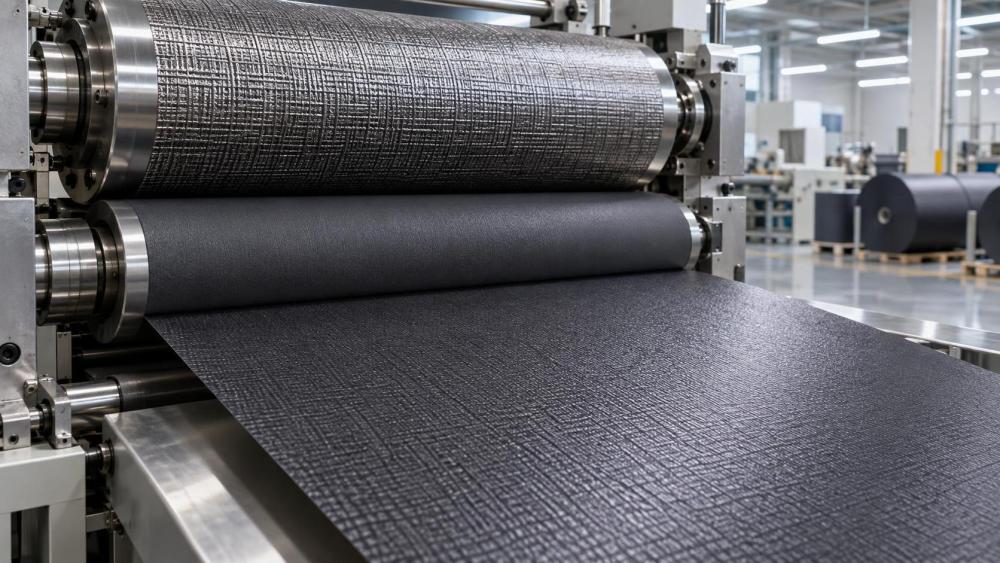
Roller Design Shapes Both Appearance and Damage Risk
The embossing roller is not merely a carrier for a decorative pattern. Its engraving depth, land area, edge radius, repeat geometry, and surface finish determine how force enters the paper. A fine engraving with narrow peaks needs accurate registration and stable pressure; small variations can create alternately weak and harsh impressions. A broad pattern distributes force across a wider area, but it can reduce overall caliper or cause a soft, indistinct texture if the counter-pressure surface is too yielding.
Male-female embossing systems provide precise contour control because the paper is formed between matching raised and recessed elements. They are useful where logo detail, lettering, or sharply bounded motifs must remain legible. Their tighter geometry also increases sensitivity to stock thickness variation and registration error. A sheet that is slightly thicker than expected can be over-compressed, while a thinner area can show incomplete formation.
Steel-to-rubber or steel-to-composition configurations provide a different balance. The compliant side can absorb small caliper fluctuations and is often better suited to continuous textures or less rigid sheets. The trade-off is lower geometric precision. If the resilient covering is too soft, fine details round off and embossed areas may vary across the web. If it becomes glazed, worn, or locally compressed, pressure distribution becomes uneven even though machine settings have not changed.
Roller cleanliness has a direct visual effect. Loose fibers, dried coating fragments, adhesive residue, or dust lodged in engraved recesses prevent the pattern from transferring evenly. The resulting defect is often mistaken for a pressure problem because it appears as weak embossing. Raising nip force may make the surrounding area darker or more compressed while leaving the blocked detail unchanged. Inspection should distinguish between a missing pattern caused by insufficient forming force and a missing pattern caused by contaminated tooling.
Pressure, Dwell, and Speed Must Be Read Together
Nip pressure receives most of the attention because it is easy to adjust, but it does not describe the full forming condition. The same pressure setting can produce different results when line speed changes, when roller diameter changes, or when the machine uses a different pressure mechanism. Contact time at the nip, often described as dwell, affects how completely the fibers conform to the engraved surface. At higher speeds, a pattern may lose definition without any change in nominal pressure. Increasing pressure to compensate can introduce crush marks instead of restoring the original texture.
Uniform pressure across the machine width is equally important. Weak impressions near one edge, a darker band in the center, or a progressive change from operator side to drive side can indicate roller deflection, bearing wear, incorrect crown, or an uneven counter-roll covering. These are machine-condition issues, not material inconsistency. Running more force through the system may briefly mask the variation while accelerating wear and increasing damage across the rest of the sheet.
Temperature can alter the process even when embossing is not intended as a thermal operation. Friction, warm rolls, or nearby drying stages can soften certain coatings, laminating layers, and surface treatments. A warmer surface may take a more pronounced texture, then show scuffing or gloss change after cooling. Conversely, cold stock can behave rigidly and reveal cracking at the pattern edge. Sampling should therefore occur after the sheet has stabilized, not only at the discharge point.
Visual Defects Often Have Different Root Causes
Uneven texture does not always mean uneven pressure. If the pattern is weak in repeating intervals, the cause may be roller runout, an engraving issue, or periodic contamination. If it varies randomly through a batch, caliper variation, local moisture differences, and sheet formation may be more likely. If embossing fades after storage, the paper may be relaxing because its structure was formed under conditions that did not remain stable.
Whitening around raised areas is another defect that needs careful interpretation. On dyed-through stock, it can result from fiber rupture or surface abrasion. On coated or colored papers, it may be a coating stress mark that exposes a lighter underlayer. On metallic papers, it can be a directional reflection effect rather than actual material loss. Viewing the sheet under different angles, examining both sides, and comparing pre- and post-fold samples prevent an incorrect adjustment.
Print interaction creates further differences. Embossing after printing may distort halftones, break fine type, or change ink gloss where the pattern stretches the image. Embossing before printing can leave a textured surface that reduces contact during lithographic or digital printing. Neither sequence is universally preferable. A solid-color field may look richer when printed before embossing, while delicate text or barcodes may need a reserved flat area or printing after a shallow texture. Registration marks, trim position, and pattern repeat must be considered together when a motif crosses printed artwork.
Quality Control Should Follow the Product’s Next Process
A flat embossed sample is only the first inspection point. Specialty paper frequently enters die-cutting, scoring, foil application, laminating, folding, or gluing after embossing. Each downstream action exposes a different weakness. Deep relief close to a score line can cause the fold to wander. Raised areas may prevent uniform adhesive contact. Foil can bridge over a sharp pattern rather than conform to it. Laminating may reduce the tactile effect or trap air over high points.
A useful evaluation sequence includes the finished visual surface, the reverse side, the sheet edges, and the next conversion operation. Inspecting the reverse side reveals whether the pattern has produced excessive show-through or broken fibers. Looking at edges can expose curl and tension imbalance. Folding a representative sample identifies cracks that are invisible while flat. Where a texture is intended for packaging, forming a small blank often tells more than increasing the size of a flat press sample.
- Pattern fidelity: inspect fine detail, repeat continuity, and whether the intended texture remains legible under both diffuse and directional light.
- Surface integrity: look for linting, coating disruption, gloss patches, color shift, and damage that appears only after flexing.
- Cross-sheet consistency: compare center and edges, then compare early and later production samples after the rolls have reached stable operating conditions.
- Functional conversion: test the actual fold, glue zone, print sequence, or die-cut relationship that the embossed paper will encounter next.
Machine Selection Changes the Range of Acceptable Papers
A machine with stable roll alignment, controlled nip loading, accurate web or sheet guidance, and accessible adjustment points supports a wider range of specialty grades. That does not mean every paper should run at the same settings. The practical advantage is repeatability: a validated combination of paper, roller set, pressure profile, speed, and conditioning state can be reproduced without relying on subjective visual adjustment.
For short custom runs, changeover precision can matter as much as maximum capacity. A small error in roller registration or counter-roll setting may consume a large share of a limited premium stock before the texture is acceptable. For longer runs, roll condition and thermal stability become more significant because gradual wear, buildup, and tension changes can shift the pattern over time. The best machine configuration is therefore linked to both the paper grade and the production pattern.
Embossing quality improves when process records describe the complete condition rather than a single pressure value. Recording stock identity, grain direction, measured caliper range, conditioning status, roller set, speed, tension, and observed surface response makes later troubleshooting much more reliable. It also prevents a successful result on one specialty sheet from being treated as a universal setting for a visually similar but structurally different paper.
The strongest specialty-paper embossing has a deliberate character: enough relief to communicate texture, enough definition to preserve the design, and enough material integrity to survive what happens after the machine. When those requirements are balanced, embossing becomes a controlled surface treatment rather than a source of hidden damage.
Related News
- How Do Embossing Machines Affect Specialty Paper Quality?Sep 16, 2026How do embossing machines affect specialty paper quality? Explore how pressure, rollers, moisture, and paper structure shape texture, durability, and premium visual appeal.
- How to size recycled pulp and paper equipment for stable outputSep 03, 2026Recycled pulp and paper equipment sizing guide for stable output—optimize fiber balance, screening, water systems, and maintainable capacity.
- What determines the output capacity of a tissue production machine?Aug 28, 2026Tissue production machine capacity depends on speed, drying, fiber quality, uptime, and converting efficiency. Discover how to achieve reliable, saleable output.
- How papermaking technology in Asia is reducing water use in millsAug 27, 2026Papermaking technology Asia is helping mills cut water use through smarter reuse, filtration, fiber recovery, and real-time process control. Explore practical strategies.