
Can low carbon brick manufacturing materially reduce kiln fuel consumption while protecting output quality and production economics? For enterprise decision-makers, the answer is yes—but only when decarbonization is treated as a production-system redesign rather than a single equipment upgrade.
A brick kiln does not consume fuel in isolation. Its energy demand is shaped upstream by clay preparation, moisture control, shaping pressure, green-brick geometry, dryer performance, stacking density, firing curves, combustion quality, and the recovery of heat that would otherwise leave through the chimney. A plant may install a cleaner burner and still see disappointing savings if wet bricks enter the kiln, air leakage remains uncontrolled, or kiln cars carry excessive dead weight.
In practical terms, low carbon brick manufacturing can reduce fuel consumption when it lowers the thermal load per saleable brick, stabilizes firing conditions, and turns waste heat into useful process energy. The strongest results come from connecting material science, process engineering, automation, and operational discipline into one coordinated plan.
Fuel use begins before the kiln is lit
Many energy-reduction discussions start at the firing zone because that is where gas, coal, oil, or alternative fuels are visibly consumed. Yet the kiln inherits much of its burden from earlier stages. If raw materials arrive with variable particle size, inconsistent organic content, or excessive moisture, operators often compensate with longer drying cycles, wider firing margins, and more conservative temperature settings. Those responses protect quality in the short term, but they also lock in avoidable fuel use.
For a decision-maker, the central question is not simply, “Which fuel should we use?” It is, “How much energy does this product design and process route require to produce a compliant brick?” That distinction changes the investment conversation.
A low-carbon production program typically examines the following linked variables:
- Raw material moisture, plasticity, particle distribution, and calorific contributions from additives;
- Green-brick density and geometry, including perforation patterns and wall thickness;
- Dryer loading, air circulation, humidity removal, and reject rates;
- Kiln insulation, pressure balance, airflow leakage, and firing-zone uniformity;
- Fuel preparation, burner tuning, oxygen control, and combustion stability;
- Waste-heat recovery opportunities between kiln cooling, drying, and preheating stages;
- Real-time measurement of energy per tonne, energy per thousand bricks, and yield-adjusted carbon intensity.
Each item may appear operationally modest. Together, they determine whether a plant is merely burning fuel efficiently or actually manufacturing bricks with a lower energy requirement.
Material formulation can reduce the heat burden—if quality is designed in
Low-carbon brick manufacturing often involves greater use of industrial by-products, recycled mineral fractions, processed demolition fines, fly ash, slag-based materials, or other locally available secondary resources. These inputs may reduce virgin-clay extraction, shorten transport distances, or modify firing behavior. However, they should never be introduced only because they sound sustainable.
Different materials affect shrinkage, drying sensitivity, color development, porosity, firing temperature, and mechanical strength in different ways. A substitution that lowers firing temperature but sharply increases cracking or deformation is not a genuine carbon improvement; it creates waste, rework, and customer risk. Likewise, some residual materials can introduce salts, volatile compounds, or inconsistent chemistry that complicates kiln control.
The more resilient route is to establish a material acceptance framework. This usually includes representative sampling, moisture and particle-size testing, chemical and mineralogical review where needed, trial batches, drying evaluation, and firing trials across a defined temperature range. The objective is to identify a formulation window that produces consistent properties with the lowest practical thermal input.
Product geometry also deserves attention. Hollow and perforated brick designs can reduce raw material use and building heat transfer, but they must remain compatible with extrusion, handling, drying, stacking, and firing. A design that creates uneven wall thickness or restricts airflow through kiln settings can increase rejects and cancel its embodied-carbon advantage. The best designs work with the line rather than against it.
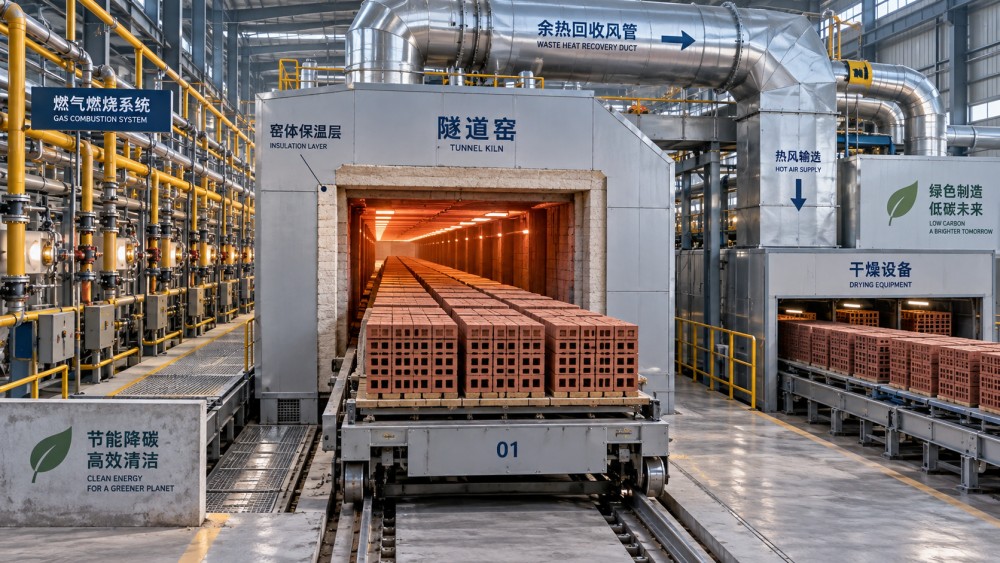
The dryer-kiln relationship is where many savings are won or lost
A common mistake is to evaluate drying and firing as separate departments. In reality, they are one thermal system. Every kilogram of water that reaches the kiln must be heated and evaporated under conditions that are usually less economical than a well-managed dryer. Excess moisture also disrupts firing stability, particularly when the kiln is expected to operate at high throughput.
Effective drying does not mean simply applying more heat. It means matching air temperature, humidity, velocity, and residence time to the brick body’s moisture-release behavior. If the surface dries too quickly while the interior remains wet, cracking can emerge later. If drying is too slow, the line loses capacity and the kiln may receive unstable feed. The operational target is uniform moisture at kiln entry, not maximum dryer temperature.
Recovered hot air from the kiln cooling zone can be valuable here. Instead of venting usable thermal energy to the atmosphere, producers can route suitable heat to dryers, combustion-air preheaters, or raw-material conditioning processes. The engineering details matter: air quality, temperature stability, duct losses, fan energy, maintenance access, and contamination risks must all be assessed. But the underlying logic is compelling—use high-grade heat where it is needed most, and avoid generating new heat for a duty the kiln is already capable of supporting.
For plants with older dryer infrastructure, incremental improvements may be more realistic than full replacement. Better airflow distribution, repaired seals, automated dampers, moisture sensors, variable-speed drives, and revised loading patterns can improve consistency without forcing an immediate shutdown of the entire line.
Modern kiln control is less about hotter firing and more about narrower variation
Fuel consumption rises when operators must maintain broad safety margins to deal with inconsistent green bricks, unreliable temperature readings, uneven circulation, or unstable fuel delivery. In those situations, a kiln may be run hotter or longer than the average product actually requires. The apparent security of “a little extra heat” can become a permanent cost.
Improved kiln control reduces that uncertainty. Temperature zones, pressure profiles, oxygen levels, exhaust composition, car movement, and burner behavior should be understood as a connected operating picture. Advanced control systems can help operators identify drift early, but technology alone is not enough. Sensors require calibration, control logic must reflect the actual kiln, and teams need authority to act on deviations before they become defects.
Combustion management is particularly important. Excess air cools the flame and increases exhaust losses; insufficient air can lead to incomplete combustion, black cores, color variation, or emissions problems. The optimum setting depends on the kiln design, fuel characteristics, brick body, firing curve, and local compliance requirements. It should be established through disciplined testing rather than copied from another plant.
Where fuel switching is under consideration, decision-makers should separate three issues: carbon intensity of the fuel, combustion efficiency, and supply reliability. Natural gas, biogas, biomass-derived fuels, electricity, hydrogen-ready systems, and blended alternatives may each have a role depending on regional infrastructure. Yet a lower-carbon fuel does not automatically lower consumption. A poorly integrated fuel change can create temperature-control challenges, increase maintenance requirements, or introduce supply volatility. The production process must be ready for the fuel—not merely connected to it.
Heat recovery changes the economics of low-carbon brick manufacturing
Heat recovery is often one of the most practical pathways for reducing kiln fuel demand because it addresses losses already present in the process. Cooling air leaving fired bricks contains useful energy. Exhaust streams may also offer recovery potential, although their temperature, cleanliness, moisture, and corrosion characteristics need careful evaluation.
The first priority is usually direct use: hot cooling air can support drying or combustion-air preheating. Direct use avoids the efficiency penalties associated with multiple energy conversions. When direct integration is not feasible, indirect heat exchangers or thermal storage may be considered, particularly where production schedules create a mismatch between heat availability and heat demand.
Not every recovery project is financially justified. Long duct routes, high fan loads, frequent production changes, or difficult maintenance conditions can erode the expected benefit. A credible feasibility study should therefore account for net energy savings, not recovered heat in theory. It should include pressure drop, auxiliary electricity, downtime requirements, maintenance access, seasonal production patterns, and the value of avoided fuel.
Measure the right performance indicators, or the project will drift
Absolute fuel consumption is useful, but it is not enough. A plant producing a different mix of formats, densities, or grades can appear less efficient even when process performance has improved. Decision-makers need a set of normalized indicators that connects energy to production reality.
Useful metrics may include fuel energy per tonne of fired product, fuel energy per thousand standard bricks, thermal energy per square metre of product, percentage of reject and downgrade output, moisture at kiln entry, kiln-specific fuel use by product family, and carbon emissions per saleable unit. The phrase saleable unit matters. Energy consumed in defective products is still energy consumed, even if it disappears from shipment records.
These metrics become more valuable when reviewed at shift, product, and campaign level. A monthly plant average can hide recurring problems: one clay source that dries poorly, one format that causes stacking restrictions, a night shift with combustion variation, or a maintenance issue that only appears at peak throughput.
Digital production records, energy meters, laboratory data, and maintenance logs do not need to become a complicated data project on day one. The practical goal is to create traceability between a change and its outcome. When a new blend, firing curve, burner setting, or dryer schedule is introduced, the plant should be able to see whether quality, throughput, fuel use, and emissions moved in the intended direction.
A realistic investment sequence for plant leaders
The most successful programs rarely begin with a headline-grabbing rebuild. They start by identifying where energy is being lost and which constraints truly govern the kiln. An energy audit should walk the material from receiving yard to finished-goods storage, combining production data with on-site observation. Operators often know where heat escapes, where loading patterns fail, or where controls are routinely overridden; their experience is essential evidence.
From there, investments can be staged. Low-capital actions may include leak repair, insulation maintenance, burner tuning, revised stacking, dryer scheduling, and tighter moisture control. Medium-scale projects may involve sensors, automated dampers, variable-speed drives, improved kiln controls, or heat-routing upgrades. Larger capital decisions—such as kiln modernization, alternative-fuel systems, electric heating components, or comprehensive heat recovery—should follow validated process data and a clear operating model.
This sequence reduces the risk of buying sophisticated equipment to solve a problem caused by poor material consistency or basic maintenance gaps. It also gives management a defensible baseline for capital approval and carbon-reporting discussions.
What decision-makers should avoid
There are several recurring traps. One is pursuing carbon reductions through fuel substitution while ignoring yield. Another is selecting a technology based on nameplate capacity rather than its fit with actual brick formats, local raw materials, and maintenance capability. A third is using broad carbon claims without establishing a credible measurement boundary.
It is also risky to assume that every low-carbon solution should maximize automation. Automation is most valuable when it improves repeatability, visibility, and response time. If plant data is unreliable or operating practices vary widely, automation may expose problems rather than immediately solve them. That is still useful—but it should be expected and planned for.
For organizations building a longer-term manufacturing strategy, the better question is not whether low carbon brick manufacturing is possible. It is where the plant’s next unit of energy reduction can be achieved with the least operational risk and the strongest commercial return.
The strategic value goes beyond lower fuel bills
Reducing kiln fuel consumption can improve more than energy costs. Stable drying and firing conditions can lower defect rates, improve product consistency, reduce exposure to fuel-price volatility, and support clearer environmental reporting. In markets where developers, distributors, and public buyers increasingly assess material footprints, a plant with transparent process data is better prepared to answer difficult procurement questions.
For leaders in the brick and broader building-materials sector, the opportunity is not a single “green” intervention. It is an integrated manufacturing discipline: formulate intelligently, dry consistently, fire precisely, recover usable heat, measure outcomes, and improve in cycles. When those elements work together, lower-carbon production becomes a practical route to lower kiln fuel consumption—not a promise detached from factory reality.
Related News
- Low-Carbon Building Materials and Brick Plant UpgradesMay 09, 2026Low-carbon building materials start with smarter brick plant upgrades. Discover how kiln efficiency, drying control, and automation can cut emissions, lower costs, and boost competitiveness.
- Technical Prestige in Brick-Making Machinery: What Signals Real QualityMay 08, 2026Technical prestige in brick-making machinery starts with proven quality. Learn the real signals of system integration, stable output, energy efficiency, and smarter supplier selection.
- Low-Carbon Building Materials: What to Compare Before Scaling SupplyMay 06, 2026Low-carbon building materials buyers: compare carbon data, compliance, equipment fit, and total cost before scaling supply. Use this practical guide to reduce risk and source with confidence.
- Production Equipment Choices That Matter Most in Brick MakingApr 30, 2026Production equipment choices can make or break brick production. Learn how to match equipment, automation, and raw material needs for higher output, lower costs, and reliable long-term performance.