
Which Industrial Equipment Market Trends Are Reshaping Capital Budgets?
Industrial equipment market trends are reshaping capital budgets because manufacturers are being asked to solve several problems at once: expand output where demand is real, reduce exposure to energy and labor volatility, meet tighter product and packaging requirements, and avoid locking money into machinery that cannot adapt to the next product mix.
That is a different conversation from the traditional “replace an old machine with a faster one” approach. In textiles, printing, papermaking, packaging, woodworking, and building-material production, the more consequential investments increasingly sit at the intersections between processes. A converting line may be constrained by inspection rather than speed. A digital printing operation may gain more from reliable color workflow management than from adding another press. A packaging plant may need hygienic design, traceability, and faster changeovers before it needs more nominal capacity.
For capital planners, the useful question is not simply which machines are trending. It is which investments remove the most expensive constraint in the operating system—and whether that improvement remains valuable if volumes, materials, regulations, or customer specifications change.
Capital is moving from standalone assets to connected production systems
One of the clearest industrial equipment market trends is the shift from isolated machine purchases toward integrated production architecture. A high-speed machine can look compelling in a supplier presentation, yet its economic value depends on the equipment before and after it. Material handling, web guiding, drying, inspection, waste extraction, palletizing, recipe control, and maintenance access often determine whether the line can actually deliver stable output.
This is particularly visible in light-industry applications. In paper converting or flexible packaging, an upgraded press without compatible finishing capacity can simply move the queue downstream. In automated woodworking, better nesting software may change material yield and cut sequencing more than a modest increase in spindle speed. In textile processing, a new dyeing or finishing asset has to be judged alongside water management, chemical dosing, drying energy, fabric handling, and quality control.
The budget implication is easy to miss: integration costs should not be treated as secondary. Controls engineering, data interfaces, guarding, commissioning, operator training, spare-parts strategy, and layout changes can materially affect the real investment. They can also be the difference between a technically successful installation and a line that operators bypass because it is difficult to run.
This is why equipment due diligence increasingly starts with process mapping. Decision-makers need to see where material waits, where defects are detected, where manual adjustments occur, and where changeovers consume time. The purchase decision should follow that map, not a generic equipment category.
Automation budgets are becoming more selective
Automation remains a major capital priority, but the strongest business case is usually not “replace people with machines.” It is “reduce variation in a task that is hard to staff, difficult to repeat, or costly when it goes wrong.” That distinction matters.
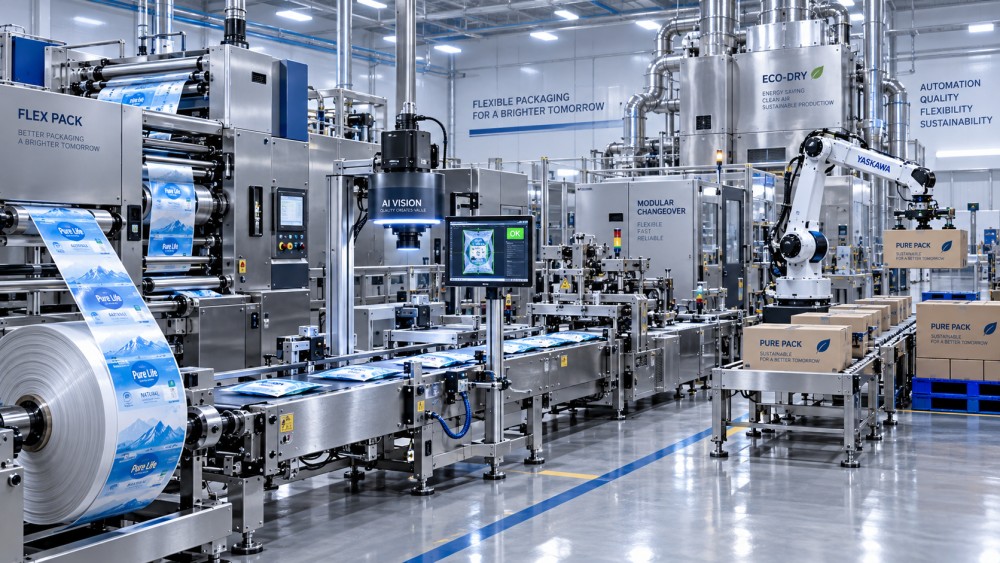
Robotic loading, automatic reel handling, vision inspection, inline weighing, recipe management, and end-of-line palletizing can all be justified in the right setting. Yet their payback depends on production rhythm. A highly variable plant with short runs may need flexible automation and quick programming rather than a fixed cell designed around one stable product. A plant running a narrow set of high-volume SKUs may reasonably prioritize throughput and labor consistency.
The uncomfortable truth is that automation can create a new bottleneck if the surrounding process is not disciplined. A robotic cell supplied by inconsistent upstream material, incomplete master data, or frequent unplanned stoppages will not produce its brochure-level performance. Before approving automation, teams should clarify who owns recipe data, how exceptions are handled, what happens during product changes, and whether maintenance personnel can diagnose the controls stack without waiting for outside support.
For many sites, the practical first step is semi-automation at the most repetitive or safety-sensitive point. It provides a cleaner view of process behavior before the company commits to a larger autonomous system. Capital discipline is not about avoiding advanced equipment; it is about sequencing it properly.
Energy performance is no longer a side calculation
Energy-intensive equipment has always required close scrutiny, but energy performance now influences equipment selection much earlier in the budgeting process. Drying, curing, thermal treatment, compressed air, vacuum systems, pumping, steam generation, and ventilation can account for a large share of operating exposure in processes such as papermaking, printing, textiles, and brick production.
The right comparison is not a simple power-rating comparison between machines. Buyers need to understand the operating envelope: production speed, substrate or material type, moisture conditions, temperature profile, start-stop frequency, heat recovery options, and the quality requirements that prevent a line from running at its theoretical maximum. A lower-rated system that causes scrap or quality instability is not necessarily the lower-cost option.
In practice, projects involving low-carbon material equipment are often judged by a wider set of conditions than fuel consumption alone. Availability of local energy sources, emissions requirements, feedstock consistency, drying conditions, maintenance capability, and local permitting all influence the investment. The same applies to food and consumer-goods packaging lines, where hygienic design and compliance requirements may constrain the equipment configuration from the start.
This is where lifecycle thinking becomes more than a finance phrase. Capital teams should ask suppliers for assumptions behind consumption figures, identify which utilities are included or excluded, and model the consequences of reduced uptime or off-spec output. The operating cost case should be transparent enough that engineering, operations, and finance can challenge it together.
Flexibility is competing with pure speed
Equipment buyers still value output, but many are placing a premium on adaptable capacity. Product lifecycles are shorter in several consumer markets, packaging formats are proliferating, and customers increasingly expect localized or customized production. That makes fast changeover, modular tooling, software-configurable settings, and material versatility more relevant to capital allocation.
Digital printing offers a useful illustration. The attraction is not only the ability to print without conventional plates; it is the ability to manage shorter runs, variable designs, and faster artwork revision. But the capital case depends on the job mix. A business with long, stable runs may still find conventional processes economically attractive. A business handling frequent design changes, promotional versions, or fragmented demand may value reduced setup burden more heavily.
The same logic applies to packaging and converting. A line designed only for today’s dominant format may be efficient until a major customer changes pack dimensions, substrate specifications, or labeling requirements. The more sensible question is whether a machine can accommodate likely variations without extensive mechanical modification, prolonged downtime, or an entirely separate production cell.
Flexibility does have a cost. A highly configurable platform may be more complex to operate and may not match the maximum speed of a dedicated line. The decision comes down to forecast confidence. Where demand is stable and standardized, dedicated capacity remains rational. Where forecast error is expensive, optionality deserves a place in the capital model.
Compliance and traceability are changing what “fit for purpose” means
Regulatory and customer requirements are not new, but they increasingly shape the equipment specification rather than appearing as a final acceptance issue. This is especially clear in food-contact packaging, hygiene-sensitive manufacturing, and export-oriented supply chains. Requirements may affect material selection, cleanability, inspection capability, documentation, batch handling, data retention, and the separation of approved and nonconforming material.
A common budgeting mistake is to include the primary machine but underfund the controls, validation, data capture, and physical segregation needed to support a compliant process. Another is to assume that a machine configuration accepted in one market will automatically satisfy requirements in another. Local rules, buyer specifications, and certification expectations need to be checked for the specific product and destination market.
Traceability also has operational value beyond compliance. When quality disputes arise, the ability to connect raw material, settings, inspection records, and finished batches can shorten investigations. But data capture should be designed around decisions people actually need to make. Collecting thousands of signals without clear thresholds, ownership, or escalation paths only creates another administrative layer.
Supply-chain resilience is influencing equipment specifications
Lead times, spare-part availability, and supplier service capacity are now part of the capital discussion. A technically attractive machine may carry operational risk if critical components are difficult to source, if the controls architecture is overly proprietary, or if field support is limited in the plant’s region. These are not reasons to reject advanced systems outright, but they should influence total risk assessment.
For equipment with long service lives, decision-makers should ask practical questions early: Which wear parts are locally stockable? Are standard industrial components used where appropriate? What remote diagnostic access is available? Can the plant maintain core mechanical systems internally? What training is included during commissioning? How will software updates be managed over time?
A resilient capital plan often combines equipment investment with a deliberate service strategy. That can include critical-spares identification, technician capability planning, supplier response expectations, and a realistic shutdown plan. The cost is visible upfront; the value appears when a production interruption does not turn into an extended commercial problem.
How to prioritize the next equipment budget
When several projects compete for funding, ranking them by headline return alone can be misleading. The better approach is to assess each project through four connected lenses: constraint removal, lifecycle cost, adaptability, and execution risk. A smaller upgrade that eliminates chronic waste or recurring downtime may be more valuable than a large expansion project whose upstream supply and downstream logistics remain uncertain.
Before final approval, it is worth pressure-testing a few assumptions. What production mix is the equipment sized for? What happens if the mix changes? Which utility, labor, maintenance, and integration costs sit outside the supplier quotation? What level of operator skill is needed to maintain quality? Where will the line be most vulnerable during commissioning? These questions are not pessimistic. They are usually where the real investment case lives.
For organizations operating across specialized manufacturing sectors, market intelligence should be used to connect technical decisions with demand signals. Shifts in pulp availability, packaging compliance, color-management requirements, automated nesting methods, or low-carbon construction-material demand do not affect every plant in the same way. The useful work is translating those external signals into a specific equipment decision, site by site.
This is the value of a system-integration view of industrial equipment market trends. Platforms such as GSI-Matrix focus on the links between vertical process knowledge and large-scale production assets: not merely what machinery is available, but how process conditions, commercial demand, and operating constraints interact. In the current market, the strongest capital budgets are rarely the most aggressive. They are the ones built around a clear production constraint, credible operating assumptions, and enough flexibility to remain useful after the next shift in demand.
Related News
- Intellectualization Manufacturing: Where to StartMay 13, 2026Intellectualization manufacturing starts with visibility, integration, and standardized data. Discover a practical framework to boost quality, efficiency, traceability, and smarter growth.
- Modularization Production: Cost or Flexibility First?May 13, 2026Modularization production: cost or flexibility first? Discover how manufacturers balance ROI, scalability, and adaptability to build smarter, future-ready production systems.
- Which economic trends justify expanding manufacturing capacity?Oct 21, 2026Discover industrial economics trends manufacturing leaders should track. Learn when demand, capacity bottlenecks, and financing justify expansion—and invest with confidence.
- Rigid packaging industry trends reshaping material demand in 2026Oct 12, 2026Rigid packaging industry trends in 2026 are reshaping material demand through circular design, recycled content, lightweighting, and resilient supply strategies.