
For manufacturers facing higher timber prices, sustainability pressure, and growing customization demand, CNC woodworking machines can reduce material waste significantly when deployed with disciplined planning and process control.
The strongest results do not come from automation alone. They come from combining accurate material data, nesting software, stable machine operation, capable operators, and realistic production scheduling.
For workshop owners and production managers, the practical question is not whether CNC technology saves wood. It is how much waste reduction is achievable in their products, workflow, and material mix.
Why CNC Woodworking Machines Change Material Efficiency
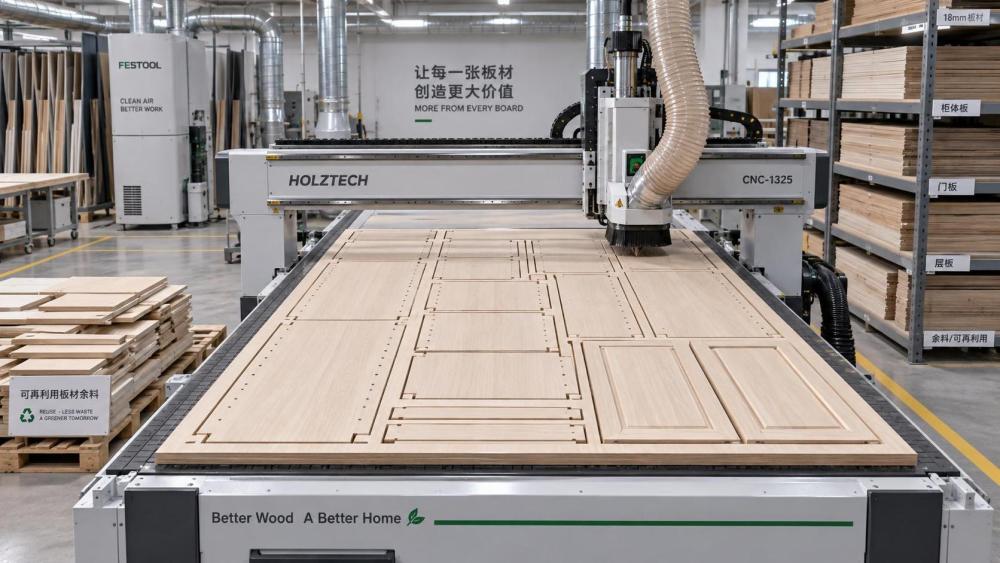
Traditional woodworking often depends on manual measuring, hand-guided cutting, fixed cutting lists, and operator judgment. Those methods can work well, but variation creates avoidable offcuts, errors, and rework.
CNC woodworking machines use programmed cutting paths to position tools consistently. This precision helps manufacturers cut panels, sheets, solid wood components, and engineered boards with less unnecessary material loss.
The central advantage is repeatability. Once a verified program is established, the machine can reproduce the same dimensions across batches without repeated manual layout decisions or measurement drift.
Material efficiency becomes especially important when workshops process plywood, MDF, particleboard, laminated panels, hardwood, veneer-faced boards, or premium imported timber with volatile purchase costs.
In panel-based production, even a small improvement in sheet utilization can create substantial annual savings. This is particularly true for cabinet, furniture, retail fixture, door, and interior-fit-out manufacturers.
CNC systems also reduce waste caused by incorrect drilling positions, wrong part orientation, inconsistent edge allowances, and inaccurate joint machining. These errors can turn otherwise usable components into scrap.
However, a CNC router cannot automatically compensate for poor production information. Incorrect board dimensions, missing grain requirements, flawed cut lists, or unsuitable tooling can still generate expensive waste.
Manufacturers should view CNC technology as an enabling system rather than a standalone answer. The machine provides precision, while process preparation determines whether that precision produces meaningful material savings.
The best business case therefore includes more than machine speed. It measures material yield, rejected parts, rework hours, setup time, labor requirements, and the resale or reuse value of offcuts.
How Nesting Software Reduces Offcuts and Unused Board Area
Nesting is usually the most direct reason CNC woodworking machines reduce material waste. Nesting software arranges multiple component shapes on a sheet to maximize usable board coverage.
Instead of manually placing rectangles based on experience, the software evaluates possible layouts rapidly. It can account for part dimensions, machining gaps, tool diameter, trim allowances, and production quantities.
A well-configured nesting strategy reduces the amount of unusable material left around components. It also limits unnecessarily large remnants that are difficult to store, identify, and reuse later.
For cabinet production, nesting can place side panels, shelves, doors, drawer parts, backs, and structural pieces together according to the available sheet sizes and required quantities.
Manufacturers handling decorative panels must also consider grain direction, pattern continuity, surface quality, and face orientation. These requirements can reduce nesting freedom, but software still improves planning accuracy.
The savings potential varies widely. Standard rectangular components usually nest efficiently, while curved parts, unusual profiles, strict grain matching, and mixed material thicknesses may limit yield improvements.
Managers should avoid relying on theoretical utilization percentages alone. A layout with excellent calculated yield may be operationally impractical if it creates difficult unloading sequences or excessive small parts.
Good nesting software supports production priorities, not just geometric efficiency. It should help balance material utilization with machining time, edge quality, labeling needs, stacking order, and downstream assembly flow.
Remnant management is another important feature. Software can record leftover sheet dimensions and recommend them for later jobs, reducing the common practice of purchasing new boards unnecessarily.
To gain reliable benefits, workshops need accurate material libraries. Sheet thickness, usable dimensions, trim margins, grain rules, supplier variation, and defect allowances must reflect actual materials on the shop floor.
Waste Reduction Depends on More Than Cutting Layouts
Optimized nesting is valuable, but cutting waste represents only one part of the material-loss picture. Production errors before and after routing can consume just as much wood.
Design changes released late can leave completed parts unusable. Strong version control between design, estimating, programming, and production prevents outdated files from entering the CNC queue.
Material identification also matters. Operators should clearly distinguish board grades, colors, thicknesses, moisture conditions, and surface finishes before loading stock onto the machine table.
Incorrect material selection can produce waste even when dimensions are perfect. A part cut from the wrong finish, wrong core type, or wrong grain orientation may require complete replacement.
Tool condition has a direct impact on yield. Dull cutters can cause tear-out, chipping, burning, delamination, or inaccurate edges that make panels unsuitable for visible furniture surfaces.
Vacuum hold-down performance deserves equal attention. Poor workholding can allow panels to shift during machining, creating inaccurate parts, damaged tools, unsafe operation, and full-sheet scrap.
Production managers should track rejects by cause rather than recording all losses as general waste. Categories might include programming errors, damaged stock, tooling issues, handling damage, and customer design changes.
This data reveals whether the CNC machine is the source of loss or merely the point where upstream problems become visible. Corrective action then becomes more specific and cost-effective.
Material waste can also occur during edging, sanding, finishing, packing, and installation. A reliable reduction program maps losses across the full workflow instead of focusing only on routing.
Where CNC Delivers the Largest Material Savings
CNC woodworking machines generally provide the greatest waste-reduction value in operations with repeatable components, substantial sheet-material consumption, frequent design variations, or high-value raw materials.
Custom cabinet manufacturers often benefit because each project includes many related components. CNC programming and nesting can turn room-specific dimensions into organized, material-efficient production batches.
Furniture factories can gain savings when producing standardized ranges at volume. Repeated programs improve consistency, while material data supports better purchasing forecasts and lower excess inventory.
Retail display producers frequently work with varied shapes, branded finishes, and short project deadlines. CNC cutting reduces manual layout time while helping teams control costly decorative board consumption.
Door and architectural millwork producers can use CNC equipment to improve machining precision for locksets, hinges, grooves, profiles, and joinery. Fewer rejected components preserve high-value materials.
Interior contractors may see additional value when machining cut-to-size panels close to installation requirements. Accurate labeling and part tracking reduce incorrect deliveries and site-related replacement waste.
Small workshops can benefit too, but their investment case is different. Savings may come less from volume and more from reducing dependency on skilled manual layout and repeated correction work.
Operations with irregular reclaimed lumber need careful evaluation. CNC can improve repeatability, but natural defects, variable board sizes, and changing grain conditions may require more manual inspection.
For solid wood production, material yield depends heavily on grading and cutting strategy. CNC helps after part selection, but it cannot eliminate natural knots, checks, warping, or moisture-related movement.
How to Measure Whether Material Waste Is Actually Falling
A waste-reduction project should begin with a baseline. Without current data, manufacturers may recognize that waste feels high but cannot verify whether CNC investment improves performance.
Start by recording purchased material volume or cost by category. Then track finished-product output, reusable remnants, downgraded pieces, scrap disposal, rework, and customer-return replacement parts.
One useful measure is material yield: the usable material incorporated into finished products divided by the total material issued to production during a defined period.
Another practical metric is scrap cost per completed unit, project, cabinet set, or production batch. This connects material loss directly to the way management prices and reviews work.
Track remnant inventory separately from scrap. A leftover panel may retain value when labeled, measured, stored correctly, and planned into another job instead of being discarded.
Managers should also calculate reject rates by process stage. A low routing scrap rate is less meaningful if downstream handling, edging, or assembly causes frequent panel damage.
Compare results by material type. Savings from standard white melamine may be modest in financial terms, while a smaller reduction in premium veneer panels may create greater margin improvement.
Review machine utilization alongside material yield. Running a CNC machine continuously does not guarantee efficiency if poor job grouping, rushed setups, or excessive remnant handling increase total losses.
A monthly review is usually more useful than isolated observations. It gives teams enough data to identify trends while allowing timely correction before poor practices become routine.
Common Obstacles That Limit CNC Waste Savings
Some manufacturers expect immediate reductions after installing a CNC router, then become disappointed when scrap remains high. Most shortfalls originate in implementation rather than machine capability.
Inaccurate bills of materials are a common cause. If the quantity, dimensions, or material specification is wrong, even the best nesting program will efficiently produce incorrect components.
Overly conservative trim margins can also reduce board utilization. Allowances should protect edge quality and panel squareness, but they should be reviewed against actual supplier consistency and machine performance.
Conversely, margins that are too tight can increase defects. The goal is not the highest possible theoretical nesting percentage, but the best dependable yield under real workshop conditions.
Untrained operators may bypass optimized workflows because manual methods appear faster during urgent jobs. Management must make correct data entry, material handling, and program verification part of normal production discipline.
Poor remnant storage undermines otherwise effective nesting. Offcuts without dimensions, material labels, or accessible locations quickly become invisible inventory and eventually become waste.
Frequent last-minute customer changes create another risk. Manufacturers should define approval gates so material is not cut before dimensions, finish selections, and hardware requirements are adequately confirmed.
Machine downtime can encourage emergency manual cutting, which may increase waste. Preventive maintenance, spare tooling, vacuum checks, and program backups protect both output continuity and material efficiency.
Finally, teams should avoid treating every offcut as a resource. Storage has a cost, and remnants should be retained only when their size, material value, and expected future use justify it.
Choosing a CNC System for Lower-Waste Production
When evaluating equipment, buyers should assess the complete production system. The router, nesting software, material handling, labeling tools, dust extraction, and operator workflow all influence waste performance.
Ask suppliers to demonstrate layouts using representative customer parts rather than generic samples. Real project data shows whether the proposed system handles your sheet sizes, grain rules, and product mix.
Software integration should be examined carefully. The CNC system should receive reliable information from design or production software without repeated manual transcription, which often introduces costly errors.
Labeling capability is especially useful for nested production. Each part can carry an identifier that supports sorting, edging, assembly, quality checks, and delivery without confusing similar-looking panels.
Consider table size and loading methods in relation to actual board formats. A machine that cannot efficiently process common supplier sheet sizes may reduce the expected material and labor benefits.
Tool-change capacity matters when jobs require drilling, profiling, cutting, engraving, and pocketing. Fewer manual interventions improve consistency and reduce the chance of incorrectly machined components.
Reliable technical support also protects material yield. When programmers or operators encounter issues, rapid support can prevent repeated trial cuts and extended production runs using faulty settings.
A realistic investment evaluation should include software subscriptions, training, maintenance, tooling, electrical requirements, dust collection, workflow redesign, and the value of recovered floor-space or labor capacity.
The right system is not necessarily the largest or most automated machine. It is the one whose capacity, software, and process requirements match the manufacturer’s production profile and growth plan.
Building a Practical Waste-Reduction Program
Manufacturers should introduce CNC-based waste reduction as a managed improvement program. Start with one product family, one material category, or one recurring production problem before expanding broadly.
First, establish the current baseline for material consumption, scrap cost, rework, and remnant use. This creates a defensible comparison point for machine settings and workflow changes.
Next, clean the underlying data. Verify part dimensions, quantities, material codes, grain requirements, machining allowances, and design revision procedures before relying heavily on automated nesting.
Run trial nests using recent completed jobs. Compare manual layouts with software-generated layouts, but also observe loading time, cutting time, unloading sequence, and downstream handling requirements.
Train operators to inspect sheets before machining. Damaged corners, bowed panels, inconsistent surfaces, and supplier defects should be identified early rather than discovered after valuable machining time.
Create clear rules for remnants. Define minimum sizes worth retaining, labeling standards, storage locations, ownership responsibilities, and a regular review process for obsolete leftover materials.
Use production meetings to review the largest waste events. A single wrongly programmed high-value board may reveal a larger process weakness than many small, unavoidable offcuts.
Set improvement targets that reflect product reality. For example, target lower scrap cost per project, higher remnant reuse, fewer rejected panels, or improved yield for selected premium materials.
Over time, the information generated by CNC production can strengthen estimating and purchasing. Better knowledge of actual yield helps companies quote work more accurately and order materials more confidently.
Conclusion: CNC Reduces Waste When Process Discipline Supports Precision
Can CNC woodworking machines reduce material waste? In most panel-processing and repeatable woodworking environments, the answer is clearly yes, especially when nesting and accurate production data are used effectively.
The greatest gains come from improved sheet utilization, fewer cutting mistakes, more consistent machining, stronger remnant control, and lower rework across the production process.
Yet CNC technology should not be judged solely by its advertised nesting percentage. Manufacturers need to measure actual scrap cost, rejected parts, remnant reuse, labor savings, and finished-product quality.
For decision-makers, the most credible approach is to evaluate a CNC woodworking system against real jobs, real materials, and real workflow constraints before making investment assumptions.
When supported by reliable data, trained teams, and disciplined process management, CNC woodworking machines can turn material efficiency from a workshop concern into a measurable competitive advantage.
Related News
- Which Safety Features Are Essential in CNC Woodworking Machines?Sep 18, 2026Which woodworking machinery safety features are essential? Explore guards, interlocks, dust extraction, tool monitoring, and safe controls for CNC machines.
- Can CNC Woodworking Machines Reduce Material Waste?Sep 16, 2026Can CNC woodworking machines reduce material waste? Discover how nesting, precision cutting, and smarter workflows improve yield, cut scrap costs, and boost production efficiency.
- What CNC Woodworking Accuracy Is Required for Cabinet Production?Sep 15, 2026What CNC woodworking machine accuracy is needed for cabinets? Discover practical tolerances for panels, holes, hinges, edge banding, and repeatable cabinet assembly.
- Separating Thickness Calibration From Surface Finish in Wide-Belt SandingSep 16, 2026Zhongding panel sanding specifications clarify how to separate thickness calibration from surface finish for consistent quality, smoother coatings, and smarter equipment decisions.